In an industry like healthcare staffing which is often dominated by a handful of major players, the concept of democratization is both crucial and controversial. At its heart, democratization of healthcare staffing is about breaking down barriers and creating a fairer playing field, especially for small, women-owned, and minority-owned businesses. For us, democratization is more than just a buzzword; it’s the driving force behind our mission to transform the locums landscape.
Syncx is not only challenging the status quo but also proving that a more equitable, value-driven approach benefits everyone. Ready to see how? Let’s dive in.
What is the democratization of healthcare?
Healthcare democratization is a framework that seeks to make healthcare accessible to everyone. It can encompass anything from open access medical information to telehealth to accessible clinical trials. A few examples of the democratization of healthcare include,
- Telehealth platforms that allow patients in rural areas or those with mobility issues to consult with specialists via video call, removing geographic and transportation barriers.
- Websites or hospital price estimator tools that allow patients to compare the cost of an MRI or a knee replacement at different facilities before they book the procedure.
- Platforms like PubMed Central or medical education resources from universities make peer-reviewed research and treatment protocols available to the public for free.
- The 21st Century Cures Act in the US mandates that patients must have immediate access to their test results and clinical notes (via portals like MyChart) as soon as they are available.
What is democratization of healthcare staffing?
The democratization of healthcare staffing promotes equal access to a free market for both healthcare facilities and providers. In the context of locum tenens (temporary provider staffing), democratization focuses on breaking down the walls of the traditional “old boys’ network.” It shifts power away from a few large, opaque staffing agencies and gives more control to the clinicians and the facility administrators who need them.
Democratization of healthcare staffing could look like:
- A community hospital in a rural area signs up for a vendor-neutral talent platform or uses a direct-sourcing managed service provider (MSP). Instead of being forced to go through a single, contracted “preferred” agency that charges high markups, the hospital can post its open shifts directly to a large pool of clinicians or invite multiple agencies to bid on the same job.
- A facility uses a platform where the “bill rate” (what the facility pays) is shown prior to engaging a provider or agency.
- By using a digital marketplace (rather than one phone call to one agency), a facility’s hiring manager can see profiles and availability from thousands of clinicians, including those who are independent and don’t work with traditional agencies.
- A mid-sized hospital uses a data analytics platform that predicts, based on historical data, that they will be short-staffed on the cardiac unit every weekend in July.
To us, this mission is more important than ever. Those in the locums industry have witnessed an accelerating shift toward further consolidation among the top 5 companies. Ten years ago, 62% of locum tenens staffing funneled through them. Today, it’s 70%, according to a recent Staffing Industry Analysts report.
This means it’s getting harder for innovative, small-to-midsize locums staffing companies to make their presence known, and even harder for healthcare organizations to find them.
Ten years ago, 62% of locum tenens staffing funneled through them. Today, it’s 70%, according to a recent Staffing Industry Analysts report.
As a next-generation MSP, democratization is the driving force behind what we do and the bedrock of our mission: creating an inclusive platform for small, women-owned, and minority-owned businesses. We bring agencies, physicians, health systems, and in-house recruiters together to easily and intuitively manage every aspect of the locums staffing process.
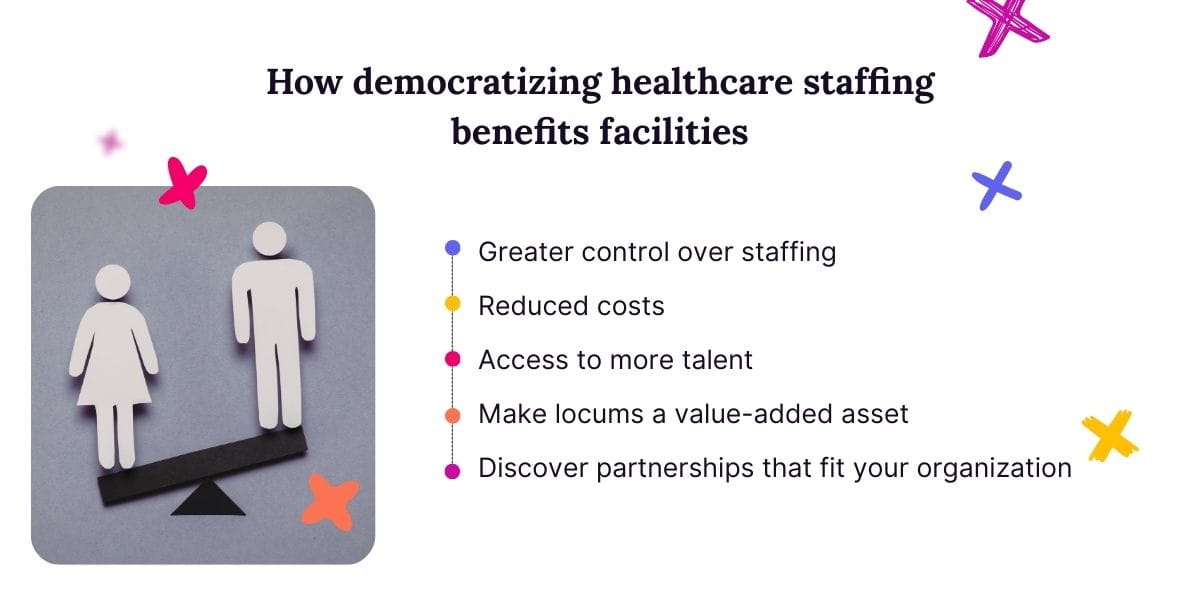
What are the goals of democratizing locums staffing?
- Take back control. You get to have a voice and choice throughout the staffing process, both in how it’s managed and how you work with vendors. It’s a refreshing alternative to being told “this is the way it is.”
- Lower your costs. The large companies in locums, and even healthcare staffing in general, keep growing. Many times, their goal of increasing profits contradicts with a healthcare organization’s goal of reducing costs. Smaller, diverse agencies are able to put service and quality before cost, and yet still come in at a lower price point.
- Access new talent. When you work with larger staffing companies, your access is restricted to their talent pool, and you’re vying with many similar organizations for the same resources. When using smaller vendors, you get access to a greater variety of exclusive talent you can’t find just anywhere, and encounter much less competition.
- Drive value. With a democratized model, locums pivots from being a “necessary evil” accepted as a sunken cost, to a value-added asset that can improve the bottom line. More individuals related to finance and management are now involved in locums conversations given the realization that democratized staffing positively impacts both patient care and facility revenue.
- Find the right partnership. Smaller agencies appreciate your business more. And, as a client, you aren’t merely a small fish in a big pond waiting alongside thousands of other organizations to get your needs addressed. Instead, you are one of a select few who the agency prioritizes, resulting in better access and better service.
Vendors and agency partners appreciate democratization as much as our clients. For them, it means direct access to clients or markets they otherwise would not be able to reach.
Making democratization of healthcare staffing a reality
For us, in order to make democratized staffing a reality, change must begin from within. So we’re intentional in who we align with, being deliberate to partner with vendors, agencies, and clients that understand and embrace our goals.
We consider things like organizational mission, makeup of the company, and the specialties they staff or need staffed. We review ownership structure, core values, market views, and their approach to quality measures. And we strive to understand whether advancing patient care and improving clinical staff is as important (or even more important) as reducing costs.
In conversations with potential partners, we make it clear that we aren’t one-size-fits-all. And that’s ok. We might not be the right partner in the moment, but that doesn’t mean down the line there may not be another opportunity. It’s important to make sure every partnership is the right fit—for both sides.
A boon to medical staffing as a whole.
We believe diversity of thought in life and in work is important. The more physician-owned, women-owned, and minority-owned small businesses contributing to our industry, the better our entire market will be.
And in the time since the new Syncx brand launched, we’ve seen we’re on to something.
First, because our clients have been so receptive, specifically seeking us out because of our democratized model. And it works for them! Check out how we helped one hospital system realize $51M in savings.
Second, because of how quickly we’ve been emulated. From the wording of our messaging to the color of our conference footwear, we’re seeing traditionally rigid, structured companies change their industry approach.
It tells us healthcare eagerly waiting for a different way of doing things. And it reinforces our drive as a forward-doing innovator to transform the staffing ecosystem. Our ultimate hope, and goal, is to improve physician coverage to ensure communities in highest need are able to access top-quality providers.
Interested in learning more about our mission or seeing how our solutions can work for you? We’re here to connect anytime.
Resources
- Physician Holding Stethoscope Photo by Sasun Bughdaryan on Unsplash
- Physician Crossing Arms Photo by Sasun Bughdaryan on Unsplash