If you’re a healthcare administrator, “locum tenens” likely enters your vocabulary during moments of stress like a sudden resignation, an unexpected medical leave, or a frustratingly long recruitment gap. It’s often seen as a necessary but complex and costly stopgap. What if we reframed that perspective?
This guide will both inform you about the basic features of locum tenens as well as answer the real-world questions your team faces: How does the cost truly compare to a permanent hire? Who handles the daunting credentialing maze? What’s our operational responsibility once they arrive?
Whether you’re covering a leave, bridging a vacancy, or exploring a new service line, understanding the “how” and “why” of locum tenens empowers you to maintain continuity, protect revenue, and support your permanent staff. Let’s begin.
What Does Locum Tenens Mean?
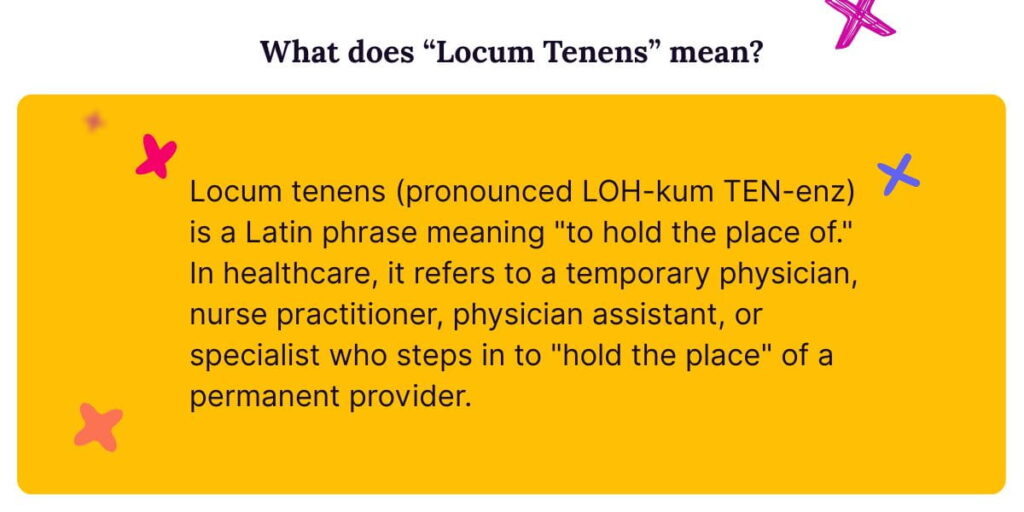
Locum tenens (pronounced LOH-kum TEN-enz) is a Latin phrase meaning “to hold the place of.” In healthcare, it refers to a temporary physician, nurse practitioner, physician assistant, or specialist who steps in to “hold the place” of a permanent provider.
For administrators, “locum tenens” doesn’t just mean hiring a temp worker, but rather partnering with a staffing agency or managed service provider that handles the complex logistics (recruitment, credentialing, licensing, travel, and payroll) for a pre-negotiated rate. This allows your team to focus on integration and operations rather than the heavy lift of finding and onboarding a temporary provider yourself.
Key Takeaway for Admin: When you engage a locums physician, you’re purchasing coverage and expertise for a defined period, with much of the administrative burden shifted to the agency or managed service provider.
How Does Locum Tenens Differ from Per Diem Staffing?
Locum tenens is best for strategic, planned coverage for longer-term gaps (e.g., parental leave, recruitment search, multi-month vacancy). Per diem staffing involves short-term, fill-in coverage for daily or weekly schedule fluctuations (e.g., same-day sick call, extra patient volume).
- Use locum tenens when you need to maintain a continuous service line or clinic schedule for an extended period. It’s a strategic solution for a known, protracted need.
- Use per diem staffing when you need to patch a schedule hole or manage day-to-day variability in patient volume. It’s a tactical solution for immediate, short-term needs.
What Are the Top 5 Reasons to Open a Locum Tenens Position?
While you can’t perfectly plan for all contingencies, several of the top use cases for locum tenens are common and can be planned for strategically.
1. To Cover Planned, Extended Absences
This is one of the most frequent and predictable uses for locum coverage. When a permanent physician or advanced practice provider takes a planned leave (for maternity/paternity leave, a medical sabbatical, or extended vacation) a locum tenens professional often steps into their role.
2. To Cover Seasonal or Spike Volumes
Whether your facility experiences an annual influx of seasonal residents, a spike in respiratory illnesses during winter months, or a short-term contract with a new employer group, temporary providers allow you to expand access and maintain timely care. Locum tenens can help you capture seasonal revenue, protect your core team from unsustainable workload increases, and ensure service quality remains high during peak periods.
3. To Bridge a Recruitment Gap for a Vacancy
A vacant position, whether sudden or anticipated, is another common use case for locums. A locum tenens provider can keep the practice operational during what can be a 6- to 12-month permanent recruitment cycle. This allows hiring teams to conduct a thorough search for the right permanent candidate, without the desperation that leads to a rushed, poor-fit hire.
4. To Alleviate Burnout and Support Retention
Chronic understaffing is a primary driver of clinician burnout. Using locum tenens to supplement your core team during periods of high demand is an investment in staff retention. By ensuring schedules are adequately covered, locums help eliminate mandatory overtime and reduce panel sizes to manageable levels.
5. Maintaining Access in Rural Markets or Hard-to-Staff Positions
For rural hospitals, community health centers, or any facility facing persistent recruitment challenges in certain specialties, locum tenens can ensure that critical services remain available to the community. By utilizing locums in these hard-to-staff roles and locations, you maintain vital referral relationships, fulfill grant or regulatory obligations for service provision, and create a continuous clinical presence.

Traditional Agency Staffing v. Internal Locums Staffing
The traditional approach to locum tenens is the agency/managed services model, a turnkey solution where the staffing partner assumes the majority of the logistical and financial burden. They recruit from a national marketplace, verify credentials, secure licenses, arrange travel and housing, and provide occurrence-form malpractice insurance, all for a single bill rate. This model offers speed, scalability, and access to a deep candidate pool, ideal for hard-to-fill specialties or immediate, unexpected needs.
In contrast, an internal locums staffing model involves directly employing or contracting with providers for temporary assignments within your own system or region. This offers greater control over scheduling, culture fit, quality standards, and costs. Custom software solutions for internal locums, such as Syncx’s float pool, empower hospital systems to take back control over contingent staffing with tools that automate and streamline staffing management so your teams aren’t strained.
For most organizations, a hybrid approach is practical: using an agency or managed services for rapid response, specialized needs, or peak demand, while developing an internal pool for more predictable, recurring coverage gaps within a familiar clinical environment.
Interested in learning more about float pool management? Discover how a partnership with Syncx allowed one hospital system to transition 43% of their locums into an internal float pool and save millions in the process.
Locum Tenens Costs
For administrators, budgeting for locum tenens requires a shift from a traditional employment cost model to a managed service model. The financials are more consolidated but involve different variables. Clarity on cost structure and comparison is key to making a sound strategic decision.
What is the typical cost structure?
Locum tenens is typically procured through a staffing agency who managed bil rates and other incidental expenses. This single, negotiated hourly or daily rate is designed to be comprehensive and predictable. It bundles core components: the provider’s taxable hourly wage, the agency’s service fee, and the provider’s malpractice insurance premiums. Travel and lodging is also covered, typically as a pass-through cost.
How do locum tenens costs compare to the full cost of a permanent hire (recruitment, sign-on bonus, benefits, etc.)?
At first glance, the hourly bill rate for a locum tenens provider appears significantly higher than the hourly salary of a permanent employee. But the Total Cost of Employment (TCE) for a permanent provider also includes employer-paid benefits (health insurance, retirement contributions, paid time off), payroll taxes, sign-on bonuses and relocation packages, and the substantial internal costs of recruitment (advertising, HR, and department time spent interviewing). Furthermore, a vacant permanent position has a massive opportunity cost in lost revenue and eroding patient loyalty.
So while the direct hourly expense is higher, it is often financially advantageous for covering gaps of less than 12-18 months, as it protects revenue, maintains market share, and allows for a deliberate permanent search.
Who handles the provider’s malpractice insurance, licensure, and credentialing? What’s our facility’s responsibility?
The agency typically assumes responsibility for the foundational administrative hurdles: they ensure the provider carries malpractice insurance, and they manage the process and costs for any required licensure and registration.
Your facility’s responsibility lies in privileging and credentialing verification. While the agency will provide a complete credentialing packet, your medical staff office must verify these credentials according to your bylaws and grant temporary or full privileges. This includes organizing any required orientation, EMR training, and system access.
Credentialing and Privileging for Locum Tenens
Once the decision to use a locum tenens provider is made, efficient onboarding is the next milestone for onboarding.
How long does it typically take from requesting a locum to having them start working?
The timeline from request to start date is highly variable, primarily dictated by the complexity of your facility’s credentialing and privileging process. For a standard assignment where a provider holds an active state license and a clean credentials packet, a typical timeline ranges from 4 to 8 weeks.
A “fast-track” scenario for immediate need might be compressed to 2-3 weeks if the provider is already licensed in your state and your medical staff office can expedite review. The most significant bottlenecks are usually obtaining a new state license, though 42 states now participate in the IMLC, a pact that allows doctors to hold a single license that makes them eligible to practice in multiple states.
Proactive communication with your agency partner about your specific timeline and providing immediate access to your credentialing requirements can shave valuable days off this process.
Who manages the provider’s schedule?
Management of the provider’s clinical schedule is unequivocally the responsibility of your facility. The locum tenens agency’s role is to deliver a qualified professional who is available for the contracted dates and hours; it is your operational team’s duty to integrate them into the workflow.
How do we ensure a locum provider has proper support staff and access to resources?
First, appoint a dedicated on-site point of contact to orient the locum and serve as their go-to for daily questions. Second, well before their start date, initiate all IT and system access requests for the EMR, dictation software, lab and PACS systems, and building security. Third, communicate clearly with your permanent support staff about the locum’s role, duration, and the clinical protocols they will follow. Finally, prepare a physical orientation packet or digital folder with maps, parking instructions, key policy documents, and contact lists. A well-supported locum integrates faster, provides higher-quality care, and represents your facility professionally.
Looking for More Control Over Locums Staffing Costs?
If the predictability of a managed service appeals to you, but you seek greater long-term cost control and system integration, there is a strategic alternative. Syncx specializes in helping healthcare organizations build and manage high-performing teams of internal locum tenens providers. This model combines the administrative ease of external staffing with the cultural alignment, loyalty, and significant cost savings of an internal solution.
Ready to see how a custom-built float pool can reduce your reliance on external agencies and transform a variable expense into a strategic asset? Schedule a personalized demo with Syncx today for a detailed cost-benefit analysis tailored to your organization’s needs.