
With patient demand unpredictable, labor costs soaring, and clinician burnout at a crisis point, the traditional model of static, full-time staff is breaking down. The question for today’s healthcare leader is no longer if you need a more agile approach, but how to implement it without sacrificing quality, culture, or your bottom line.
Flexible staffing is the strategic answer. This article breaks down what flexible staffing is, why it’s non-negotiable for modern organizations, and how to deploy it to protect your organization, your teams, and the patients you serve. Let’s dive in.
What Is Flexible Staffing in Healthcare?
Flexible staffing is a workforce model that relies on agile talent to maintain coverage when there aren’t enough available FTE providers. At its core, flexible staffing is an umbrella term for intelligently leveraging a blend of workforce solutions to match patient volume and acuity needs, discussed in more detail below.
Flexible staffing is less about replacing FTE positions with temporary workers and more about building a resilient ecosystem around your core staff. The goal is to create a buffer against volatility, ensuring that your permanent team can operate sustainably without constant burnout, while your organization never turns away patients due to a lack of staff.
Why Does Healthcare Need Flexible Staffing?
While there are limitless applications of flexible staffing in healthcare, our experience has shown us that there are three core reasons why organizations frequently choose flexible staffing:
1. To Mitigate Chronic Workforce Shortages & Burnout
The Association of American Medical Colleges projects a shortage of up to 86,000 physicians by 2036, and nursing turnover remains persistently high. By strategically filling gaps, organizations seek to protect their core staff from unsustainable workloads.
2. To Manage Explosive Demand Volatility
A rapidly aging population means explosive demand for healthcare. Many fixed-cost FTE models are not able to stretch or shrink to meet these peaks and valleys, causing organizations to seek out other options. Flexible labor acts as a variable cost lever, allowing leadership to scale capacity up or down in alignment with real-time demand.
3. To Control Soaring Labor Costs
While premium labor (locums, per-diem) carries a higher hourly rate, its strategic use is a cost-containment tool. It reduces reliance on even more expensive options like overtime or incentive bonuses. More importantly, it prevents the catastrophic revenue loss associated with bed closures or canceled procedures due to understaffing.
4 Common Flexible Staffing Models for Healthcare Organizations
For the modern healthcare organization, it’s not about whether to adopt a flexible model, but how to do it strategically, efficiently, and in a way that supports your organizational culture. Here are four ways that’s currently happening:
1. Internal Float Pools
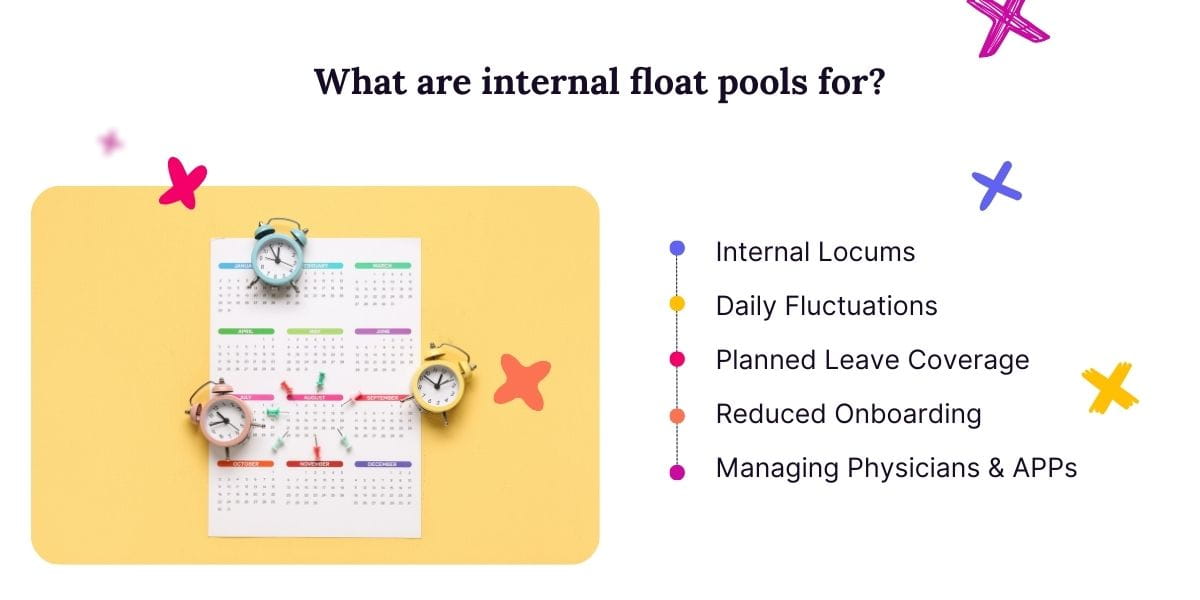
Often called “internal agencies” or “internal locums,” this model builds an internal bench of employees (physicians, APPs, and/or nurses) who work exclusively in a variable capacity by covering gaps across units, shifts, or facilities within the health system. They are typically paid a premium hourly rate or differential but do not receive full benefits.
Internal float pools are ideal for managing daily fluctuations in census and acuity, planned leave coverage, and reducing reliance on expensive external agencies. It’s the first line of defense for predictable volatility. Another key benefit of float pool staff is that they are immersed in your organization’s protocols, EMR, and culture. They offer higher continuity and faster onboarding than external staff, leading to better team integration and patient experience.
Interested in learning more about internal float pools? Schedule a demo with Syncx today to find out how you could be cutting costs and reducing your reliance on expensive agencies.
2. Per Diem Staffing
This model engages external clinicians on a shift-by-shift basis, typically through a staffing agency or direct contract. Per diem staff are employees (1099 or W-2) that are brought in for immediate, short-term needs without a long-term commitment.
They are perfect for addressing last-minute call-outs, acute short-term shortages, and filling highly specialized single shifts (e.g., a perfusionist for a specific surgery). It’s the “spot market” for labor. Advanced vendor management systems (VMS) now allow managers to book qualified per diem staff for specific shifts with a few clicks, often within hours. However, while fast, costs can escalate without strict rate controls and shift caps.
Discover how Syncx’s powerful VMS is helping healthcare organizations across the country find the right coverage without breaking the bank.
3. Locum Tenens
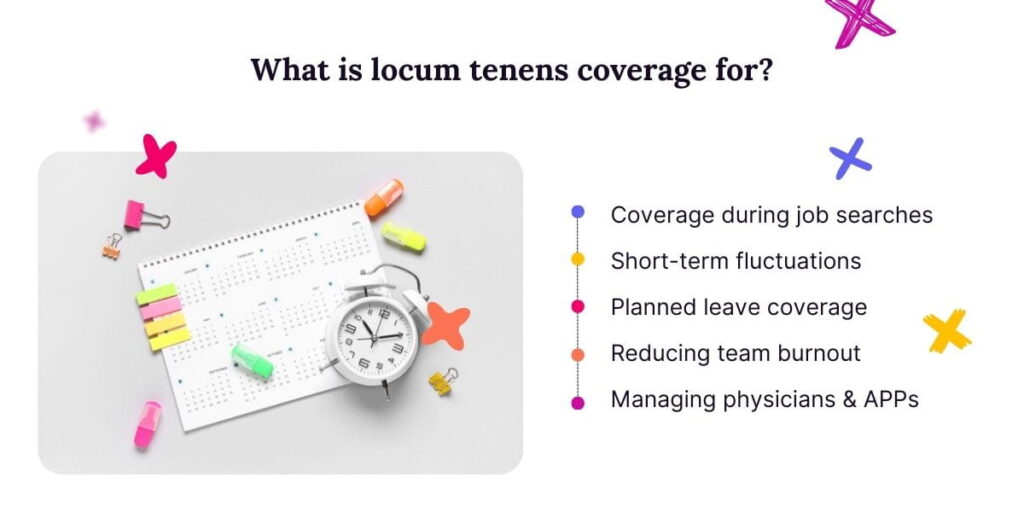
A long-established model primarily for physicians and advanced practice providers (APPs), locum tenens involves contracting a clinician for a defined assignment, typically ranging from a few weeks to several months. They temporarily assume the full clinical responsibilities of a position.
Locums is critical for maintaining service line continuity during physician recruitment (which can take 6-12 months), covering sabbaticals or extended leaves, and providing interim leadership for a clinical department. While daily rates are high, the total cost is often justified against the massive revenue loss of a closed practice.
Syncx offers several solutions for improving your locum tenens costs and time to fill rates. Reach out to us today to learn more about managed services or taking your locums in-house with a float pool!
4. Hybrid Staffing (Telemedicine)
This model involves licensed clinicians working remotely to supplement on-site teams, performing tasks like tele-ICU monitoring, virtual nursing (admissions/discharge education, patient surveillance), remote case management, or telehealth consultations.
Hybrid staffing expands capacity without adding physical beds. It efficiently extends the reach of your most specialized experts (e.g., stroke neurologists, psychiatrists) across a regional network. It also creates new, flexible work options that can attract and retain clinicians seeking non-traditional roles.
In terms of costs, it requires investment in secure technology infrastructure, clear delineation of virtual vs. in-person responsibilities, and change management to foster collaboration between remote and bedside teams.
Who Benefits from Flexible Staffing?
A well-executed flexible staffing strategy creates a classic win-win-win scenario, delivering measurable value to every stakeholder in the healthcare ecosystem.
- C-Suite & Financial Leaders: This model provides predictable cost management and revenue assurance. By converting fixed labor costs to variable where appropriate, it protects margins against demand volatility. The ROI manifests in reduced overtime, minimized bed closures, and preserved capacity.
- HR & Workforce Leaders: Flexible staffing is the primary tool for reducing burnout and improving retention of your core, permanent staff. It also provides a “try before you buy” pipeline for potential permanent hires and allows for more strategic, less desperate, recruitment cycles.
- Core Clinical Staff: Key benefits include sustainable workloads and peer support. When flexible staff absorb the shock of high census and acuity, permanent staff can practice at the top of their license, experience less moral distress, and enjoy a healthier work-life balance.
- Patients & Families: Ultimately, every benefit above converges here: consistent access to safe, high-quality care. Flexible staffing prevents delayed procedures, long wait times, and unit closures. It ensures that care teams are adequately supported, which translates directly to better attention, communication, and clinical outcomes for the patient.
What Drawbacks Arise from Flexible Staffing?
While the strategic advantages are compelling, unmanaged flexible staffing introduces risks that leaders must proactively address.
A constant influx of temporary staff can dilute organizational culture and create divisions between core and flexible teams. To head this off, we recommend implementing at least a partial universal onboarding for all staff, regardless of tenure. It’s also beneficial to include flexible staff in unit huddles and recognition programs where appropriate. Of course, you should also partner with vendors (like Syncx) who prioritize cultural fit and communication.
Similarly, inconsistent training and unfamiliarity with facility-specific protocols can lead to care variations and compliance gaps. The best early remedy for this is to choose partners with robust credentialing processes, quality assurance programs, and clear performance metrics.
Finally, without centralized management, premium labor spending can spiral across different departments and vendors, creating budget overruns. You can utilize a Vendor Management System (VMS) for a single source of truth on spend, utilization, and performance.
Let Us Create a Flexible Staffing Model That Works for You
Building a resilient, cost-effective, and high-quality care delivery system where your permanent staff can thrive is no small feat. This is where a strategic partner makes all the difference.
At Syncx, we specialize in taking the operational burden and guesswork out of flexible staffing. We offer managed services for both locum tenens and float pool management, providing you with a single point of accountability and a data-driven strategy tailored to your organization’s unique culture and financial goals.
We don’t just provide clinicians; we provide peace of mind. Our approach ensures:
- Seamless integration that supports, not undermines, your team culture.
- Predictable, controlled costs with full visibility into your flexible labor spend.
- Guaranteed quality through rigorous vetting and performance alignment.
Ready to move from reactive staffing to strategic workforce resilience? Read about how we’ve saved our partners millions in flexible staffing costs, or get a personalized demo and see how Syncx can help you design and manage a flexible staffing model that works for your people, your patients, and your bottom line.