To maintain continuity and quality of care during volume spikes and unexpected absences, organizations increasingly rely on contingent labor (locum tenens physicians, travel nurses, and per-diem staff). Yet, this approach often evolves into a sprawling and risky operational challenge in everything from sourcing to credentialing to spend.
Enter the Vendor Management System (VMS) and the Managed Service Provider (MSP), two foundational tools for transforming a reactive, costly staffing process into a streamlined, compliant, and data-driven strategic function.
This article is your essential guide. We will define what a VMS is in the healthcare context, detail who benefits across your organization, and explain what sets these systems apart from generic procurement tools. We will provide a clear framework for selecting the right solution and demystify the critical partnership between a VMS and an MSP. Finally, we will explore how a fully integrated, vendor-neutral approach delivers not just visibility, but genuine empowerment and control. Let’s begin.
What Is “VMS” in Staffing?
“VMS” stands for Vendor Management System, and it is a specialized technology platform that centralizes the procurement and management of contingent labor and external service providers. While the term is used across industries, in healthcare it addresses the unique challenge of managing a flexible, qualified workforce to meet fluctuating patient demand while maintaining strict standards for quality, compliance, and cost control.
A healthcare VMS functions as an operating system for the entire contingent workforce lifecycle, from requisition and credentialing to timekeeping, billing, and performance analytics. It provides a single, governed point for standardization and cost optimization.
Who Benefits from a VMS?
The implementation of a robust VMS creates a ripple effect of benefits across the healthcare organization, touching virtually every stakeholder:
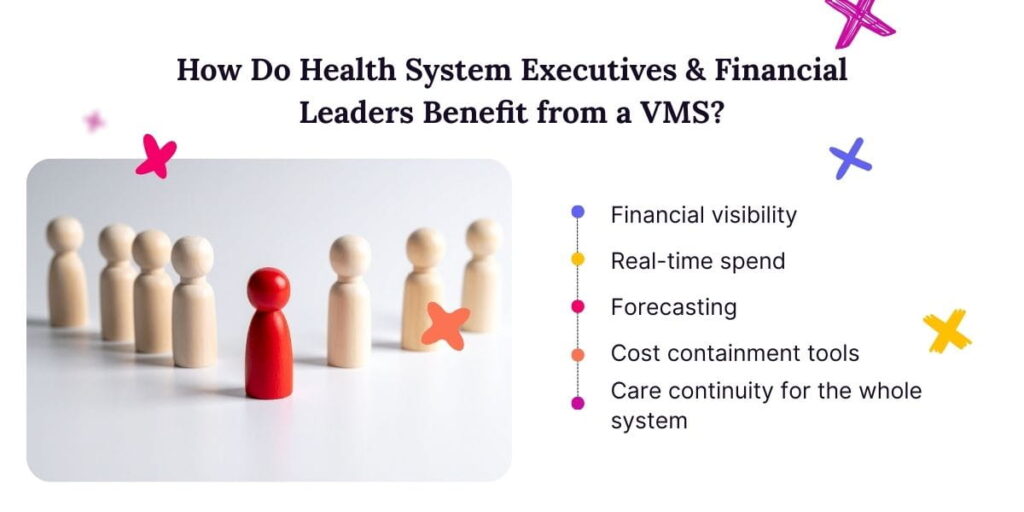
Hospital and Health System Executives & Financial Leaders benefit from significantly enhanced financial visibility and control. A VMS provides real-time data on contingent labor spend, enabling better budgeting, forecasting, and cost containment. It turns opaque spending into actionable intelligence for strategic decision-making.
HR and Credentialing Professionals experience a transformation in compliance management. The system automates the tracking and validation of crucial documents like state licenses, certifications, immunization records, and background checks, sending alerts for renewals. This creates a reliable, audit-ready “single source of truth” for contingent staff credentials.
Contingent Staff and Approved Vendors can access open shifts more easily, while staffing agencies receive clear requirements, standardized submissions, and prompt feedback within a governed framework, improving the partnership experience.
The Organization as a Whole realizes improved patient care and operational resilience. By ensuring shifts are filled promptly with qualified personnel, a VMS directly contributes to safe staffing levels, reduces clinician burnout, and enhances care continuity.
What Makes a Healthcare VMS Unique?
While Vendor Management Systems exist in other sectors, a healthcare VMS is built to manage the most vital asset in healthcare: qualified clinical human capital. At its core, a healthcare VMS is engineered to enforce clinical quality and patient safety through rigorous, automated compliance.
The system must actively manage, verify, and monitor a dynamic set of clinician-specific credentials. Furthermore, the system must provide real-time clinical operational intelligence. It answers urgent questions: Do we have a cardiologist for the 7 p.m. shift? Can we source a tele-radiologist within the hour? This need for speed, specificity, and absolute confidence in qualifications, all while integrating with complex clinical workflows and financial systems, sets the healthcare VMS apart as a specialized piece of operational infrastructure.
How Do You Choose the Right VMS?
Selecting a VMS is a strategic decision that requires alignment across clinical, financial, and operational leadership. A structured evaluation framework is essential.
1. Conduct an Internal Discovery
Begin by forming a cross-functional team from Finance, Clinical Leadership, HR/Credentialing, Procurement, and IT. Diagnose your current state: map the pain points in your contingent labor process, calculate total spend (including hidden costs), and define your core objectives.
Is the primary goal cost control, compliance assurance, operational fill-rate efficiency, or all three? This internal clarity is the foundation for your selection criteria.
2. Prioritize Healthcare-Specific Functionality and Compliance
The platform must be purpose-built for healthcare. Scrutinize its credentialing engine, and ask for information about its ability to automate essential processes. Ensure it supports the specific contract types (e.g., per diem, travel, local contract) and billing models prevalent in healthcare.
3. Evaluate Integration Capabilities and Vendor Ecosystem
A VMS cannot be an island. Its ability to integrate with your Human Resources Information System (HRIS), Financial systems, and your scheduling system is vital for data integrity and workflow efficiency. Furthermore, assess the vendor’s existing network of approved staffing partners. A robust, pre-vetted supplier ecosystem can accelerate implementation and provide immediate access to quality talent pools.
4. Assess the Vendor as a Strategic Partner
You are not just buying software; you are entering a partnership. Evaluate the vendor’s industry tenure, implementation methodology, and depth of customer support. Speak to reference clients with similar organizational profiles. Understand their roadmap: is their innovation aligned with future trends in healthcare workforce management, such as predictive analytics or direct sourcing tools?
5. Analyze Total Cost and Return on Investment (ROI) Model
Beyond the software subscription fee, consider implementation costs, potential IT resource needs, and change management. A strong vendor will help you model the ROI based on hard savings (reduced bill rates, invoice error reduction) and soft savings (decreased administrative time, lower compliance risk). The chosen solution should clearly demonstrate its path to value.
Want a real-life example? Read about how Syncx saved one client over $51 million after they transitioned to our vendor-neutral platform.
How Does a VMS Differ from an MSP?
It is common to hear the terms VMS (Vendor Management System) and MSP (Managed Service Provider) used together as they represent complementary components of a common workforce strategy. There are key differences, however.
A Vendor Management System (VMS) is the technology platform, or the specialized software that automates and governs the entire process of ordering, onboarding, and paying for contingent labor. It is the central nervous system, providing the digital infrastructure for requisitions, credentialing, timekeeping, and reporting. A VMS enforces rules and provides visibility, but it does not, on its own, perform the active, strategic management of the program or the supplier relationships.
A Managed Service Provider (MSP), in contrast, is the strategic service and expertise layer. An MSP is an external partner that assumes operational responsibility for the entire contingent workforce program. This team of experts performs the hands-on work: they negotiate rates with staffing vendors, curate and manage the supplier pool, perform direct candidate sourcing, ensure continuous compliance, analyze market trends, and act as the single point of contact for all stakeholders. They use a VMS as their primary tool to execute these services efficiently and transparently.
For a deeper dive, check out our blog on how a VMS differs from an MSP.
Discover Empowering, Vendor-Neutral Management from Syncx
While a VMS provides the essential framework for control, achieving true optimization requires the strategic expertise and active management that technology alone cannot deliver. This is where the Syncx difference becomes clear.
Syncx operates as your dedicated, vendor-neutral Managed Service Provider (MSP), powered by our own proprietary, healthcare-specific VMS. We move beyond simple software provision to become an extension of your team, taking on the full operational burden of managing your locum tenens and contingent workforce program. Our model ensures you receive unbiased, market-informed recommendations, as our success is tied to your outcomes, not to favoring any particular staffing vendor.
Ready to transform your contingent workforce from a cost center into a strategic asset? Let us show you the Syncx advantage. Schedule a personalized demo today to see our vendor-neutral VMS platform and managed services in action.