If you listen to the physicians in your organization, you’ll hear more than just fatigue—you’ll hear a profound sense of frustration. They entered medicine to heal, but find themselves battling systems that seem designed to hinder that very purpose. This gap between their mission and their daily reality is the core of the crisis. To close it, we must first have the courage to name the problems.
What follows are five tough truths about physician burnout that explain why our current efforts are falling short and what we must do differently.
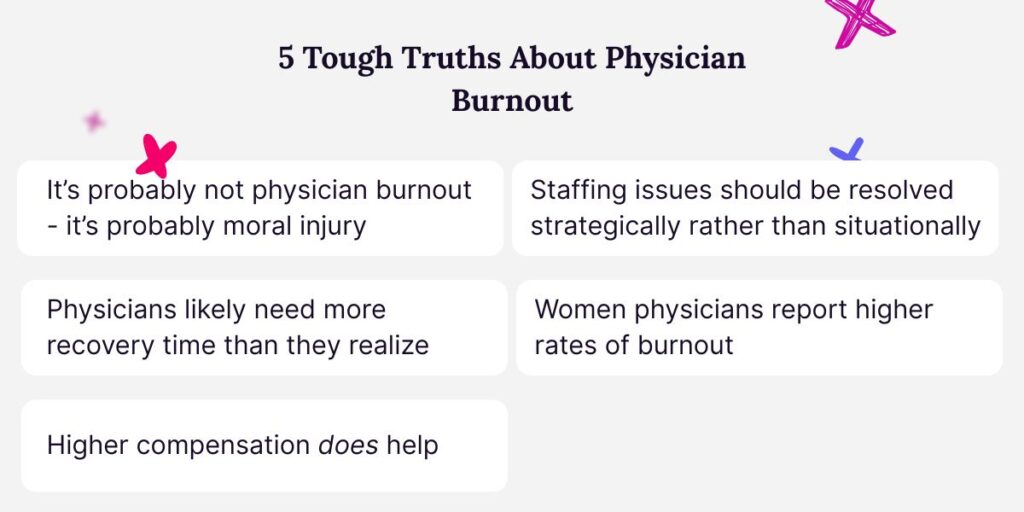
1. It’s probably not physician burnout – it’s probably moral injury
For years, we’ve used the term “burnout” to describe the physician crisis. We’ve invested in wellness programs, resilience training, and yoga classes. Yet, the problem persists and deepens. Why? Because we’ve been largely misdiagnosing the disease.
The more accurate diagnosis is moral injury.
Coined in a military context, moral injury refers to the psychological, social, and spiritual suffering that results from perpetrating, failing to prevent, or bearing witness to acts that transgress one’s deeply held moral beliefs and values. The Commonwealth Fund describes moral injury as “a profound sense that you’ve betrayed your own ethical code (or were unable to follow it because of external factors), or that people you trusted have betrayed some fundamental obligation.” In medicine, this isn’t about a lack of personal resilience; it’s about the systemic failure to allow physicians to deliver the care they know their patients need.
The Commonwealth Fund explains how peer-to-peer support programs for physicians have been proven to have a positive impact on burnout rates because they can work to directly address moral injury. For example, they discuss OSU’s Brief Emotional Support Team, a program that provides distress relief to doctors by training their peers to provide day-to-day emotional support and advice.
When a physician is “burned out,” what you are often seeing is the cumulative effect of a thousand small betrayals of their oath. To address this issue, leaders can start asking, “Where are our systems forcing our best clinicians to violate their own ethical standards?” In this way, they can work toward a top-down overhaul of the bureaucratic and operational barriers that stand between your physicians and high-quality patient care.
2. Physicians likely need more recovery time than they realize
We operate under the assumption that a high-performing professional can work 60-80 hour weeks, navigate immense cognitive loads and emotional distress, and then “recover” over a standard two-day weekend. The neuroscience of stress and performance tells us this is a fantasy.
The intense, sustained attention required in clinical medicine—coupled with the emotional weight of life-and-death decisions—creates a level of cognitive fatigue that is not comparable to most other professions. The brain, like a muscle after an extreme workout, requires significant time and the right conditions to repair itself.
Research on cognitive load and decision fatigue shows that repeated, high-stakes decision-making depletes a finite mental resource. Furthermore, the chronic activation of the body’s stress response system has measurable physiological consequences. True recovery from this state isn’t about just stopping work; it requires prolonged periods of psychological detachment.
Unfortunately, your physicians are likely chronically under-recovered. They may not even remember what true recovery feels like. A Saturday spent catching up on charting is not recovery. A Sunday dreading Monday is not recovery. The current model of limited PTO and stacked clinic schedules is fundamentally incompatible with sustainable human performance.
We must move beyond the industrial-era model of time off and design schedules that proactively build in protected, uninterrupted recovery time. This isn’t a luxury; it’s a non-negotiable component of maintaining clinical acuity and preventing errors. Consider:
- Mandating minimum intervals between shifts.
- Creating “charting-free” periods or protected administrative time.
- Actively encouraging and modeling the use of vacation time without digital leash.
- Exploring innovative staffing models that explicitly prioritize recovery as a core component of the care team’s design.
Investing in physician recovery isn’t a cost; it’s a direct investment in the quality, safety, and longevity of your clinical workforce.
3. Higher compensation does help
It’s a comfortable narrative to believe that physician burnout is purely a problem of the soul, solvable with better workflows and resilience apps. But according to a survey by MSDC, fewer than a third of physicians feel they are compensated fairly for their work. 8 out of 10 physicians in that same survey said they were also dissatisfied by their workload.
While money alone cannot fix every problem, it is a critical form of respect, a tangible acknowledgment of immense effort, and a necessary buffer against the daily toll of the job.
The “tough” part of this truth is that it hits the bottom line. It’s easier and cheaper to launch another wellness initiative than to fundamentally re-evaluate compensation models. However, when physicians are fairly paid, it does several things:
- It validates their immense sacrifice and skill, reducing the feeling of being exploited.
- It provides the financial means to achieve a better quality of life outside of work, which is essential for true recovery.
- It directly addresses the “value” side of the “value-versus-effort” equation that is at the core of burnout.
Underpaying your physicians while piling on bureaucratic burdens is a recipe for exodus. A competitive salary makes the struggle feel more equitable. It is the baseline condition that makes all other retention efforts credible.

4. Staffing issues should be resolved strategically rather than situationally
The healthcare staffing crisis often feels like a relentless game of whack-a-mole. A provider leaves, and the immediate response is to offer massive incentives for locum tenens or mandate overtime for existing staff. But always being in the position of having to put out the immediate fire is financially draining and hurts long-term team morale.
This reactive cycle treats staffing as a series of isolated incidents rather than a core strategic vulnerability. It burns out your most loyal physicians by consistently increasing their workload to cover gaps, and it fails to address the root causes of why people are leaving.
The solution is to shift from a reactive staffing model to a proactive workforce strategy. This requires a fundamental change in perspective:
- Predict & Plan: Use data analytics to forecast attrition and plan recruitment pipelines far in advance, not after a resignation letter is received.
- Invest in Retention as Aggressively as Recruitment: The most cost-effective recruitment strategy is not having to recruit. What are you doing to make your current physicians want to stay for their entire careers?
- Build a Flexible, Scalable Model: Develop internal float pools, create phased retirement options, and work with a trusted locums MSP that can help drive down costs. In fact, you can find out how Syncx save one major healthcare system $51 million in 4 years by giving them control over their locums spends.
Stop asking, “How do we fill this shift next month?” and start asking, “How do we build a clinical workforce that is resilient, sustainable, and attractive for the next decade?” This strategic view is the only path off the hamster wheel of perpetual staffing crises.
Find out how Syncx can help you build sustainable infrastructure for temporary staffing that puts your healthcare organization back in control.
5. Women physicians report higher rates of burnout
The data is consistent and unequivocal: women physicians experience burnout at significantly higher rates than their male colleagues. According to a survey conducted by the AMA, 54.5% of women physicians report experiencing burnout compared to only 42% of men. Unfortunately, the reality is that the structure of most healthcare organizations and the hidden curriculum of medical culture create a disproportionately heavy burden for women.
This disparity is not a reflection of resilience, but of the cumulative weight of systemic factors. Women physicians are more likely to face the “double shift” of domestic responsibilities, encounter gender-based discrimination and microaggressions, and bear the brunt of patient expectations for emotional labor. Furthermore, they often operate within systems and schedules designed for a traditional, single-breadwinner model, lacking the flexibility needed to navigate their multifaceted roles.
Leaders must address the specific structural and cultural barriers that drive this disparity. This requires:
- Conducting a formal equity assessment of your scheduling, promotion, and compensation practices.
- Implementing and normalizing flexible work arrangements and part-time tracks without career penalties.
- Creating and funding robust, accessible mentorship and sponsorship programs for women physicians.
- Actively addressing gender bias and fostering a culture of psychological safety where microaggressions are not tolerated.
Building an environment where women can thrive is one of the most powerful strategic investments you can make in the long-term health of your physician workforce.
The Staffing Remedy Your C-Suite Needs to Know About
Addressing physician burnout and moral injury requires a fundamental rethinking of your clinical workforce strategy. While you work on long-term systemic fixes, you must also stabilize your teams today. This is where a strategic partner can make all the difference.
Syncx, a leading locum tenens Managed Service Provider (MSP), provides more than just temporary physicians; we deliver a data-driven, fully managed solution to your staffing challenges, reducing administrative burden and ensuring continuity of care. Stop letting staffing shortfalls derail your wellness initiatives.
Ready to build a more resilient and sustainable physician workforce? Schedule a demo with Syncx today to see how our strategic approach to locum tenens can support your physicians and your bottom line.