
The healthcare staffing industry is at a turning point. Between rising labor costs, complex compliance demands, and the constant pressure to fill shifts quickly, traditional methods of recruiting and workforce management are no longer enough. Manual processes lead to invoicing errors that trigger costly clawbacks. Slow credentialing delays placements for weeks. Underperforming agencies drain resources without delivering results.
But what if technology could turn these challenges into opportunities? AI-driven tools are now reshaping every facet of healthcare staffing, from automating repetitive tasks to helping predict staffing shortages before they happen. Platforms like Syncx are at the forefront, offering smarter ways to manage invoices, credentials, and talent pools while reducing risk and improving efficiency. In this blog, we’ll explore the innovations transforming the industry, and how forward-thinking organizations are leveraging them to work smarter, not harder.
The future of healthcare staffing is already here. Are you ready for it?
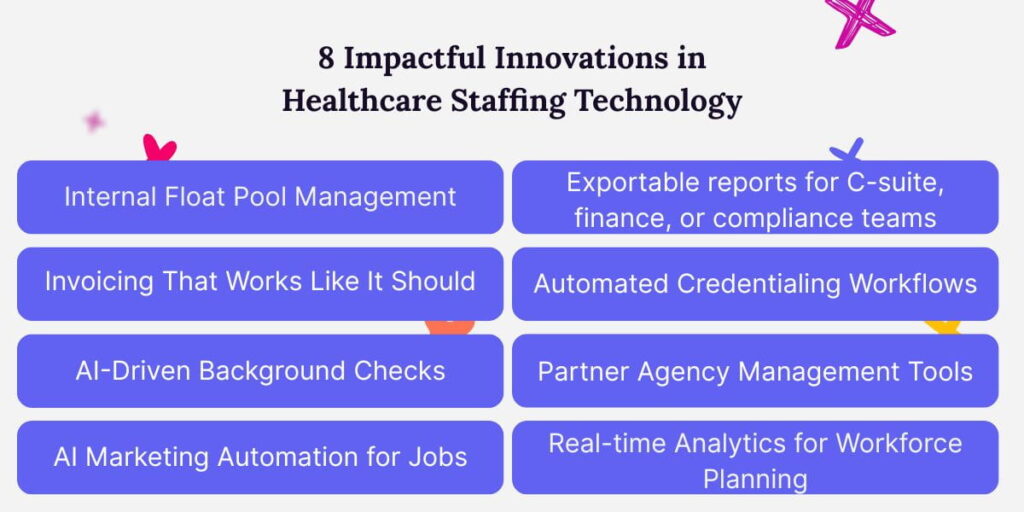
1. Internal Float Pool Management
Healthcare systems are increasingly relying on internal float pools to maintain staffing flexibility while reducing dependency on expensive agency labor. However, managing these pools manually often leads to underutilized talent or last-minute shortages. Advanced platforms now align float pool staff with anticipated demand, factoring in variables like seasonal illness trends, staff certifications, and even individual preferences for shift types. For example, Syncx’s float pool provides system-wide shift overviews and can notify qualified participants of open shifts that match their credentials, maximizing both coverage and employee satisfaction.
The real power of these tools lies in their ability to turn float pools from a reactive stopgap into a strategic asset. By analyzing historical data, they can enable proactive workforce planning. This not only reduces costly agency spend but also creates more consistent schedules for float pool staff, improving retention.

2. Invoicing That Works Like It Should
Invoicing has long been the bane of healthcare organizations working with external staffing partners. In the future, we expect many of the current issues plaguing invoicing to become obsolete through mechanisms like real-time clocking and attendance capture. Providers log hours directly into the VMS (daily, weekly, or per shift), and automated prompts and mobile-friendly inputs keep entries accurate and on-time.
Most crucially, the VMS systems of the future will stave off invoicing errors. The VMS will ensure that shift types, units, on-call, and mileage are all accounted for, while alerting you of missing or inconsistent time submissions before approval. Before anything gets billed, the system checks time against contract terms, rate cards, and credentialed roles. Built-in contract logic will prevent off-rate charges, and error detection should be deployed to highlight overtime, misaligned shifts, or duplicate entries. The bottom line? No more surprises on invoicing.
At Syncx, we’re committed to reducing disputes before they hit A/P and gives you full audit trails behind every invoice line item. Less delay. Less doubt. Fewer accrual headaches.
3. AI Marketing Automation for Jobs
The healthcare staffing industry is undergoing a quiet revolution as AI-powered tools transform traditional recruiting workflows. These platforms create and optimize job descriptions while personalizing outreach at scale. For example, Felix by Syncx creates high-performing descriptions that improve job post visibility, then automatically distributes listings across niche boards and major job sites simultaneously.
- Dynamic job description generation tailored to specialty and compliance needs.
- Smart email workflows that personalize outreach while saving recruiters hours.
- Multi-platform posting to expand reach without extra effort.
What sets next-gen tools apart is their ability to maintain a human touch while handling logistics. They can draft warm, conversational emails that reference a candidate’s specific experience, or adjust outreach timing based on when healthcare professionals are most active. Beyond simply saving time, tools like Felix create strategic advantages in a talent-short market where speed and relevance determine placement success.
4. AI-Driven Background Checks
In healthcare staffing, every day a position goes unfilled can mean lost revenue, but hiring the wrong candidate can trigger costly errors. AI is solving this dilemma by making background checks both faster and more thorough. This proactive both protects against hiring mistakes and builds trust between agencies/MSPs and healthcare facilities.
5. Exportable reports for C-suite, finance, or compliance teams
Errors have long been a pain point in healthcare staffing, where billing disputes can strain relationships between health systems and agencies while creating cash flow headaches. Modern platforms are tackling this by shifting dispute resolution upstream, allowing agencies to flag potential invoicing errors before payments are processed. For example, Syncx MSP allows you to flag and quarantine invoices that contain errors. Crucially, unflagged invoices continue processing on schedule, ensuring providers aren’t penalized for administrative issues.
This proactive approach transforms invoice management from reactive damage control to a streamlined auditing process. For healthcare systems, this means far fewer costly errors. And for staffing firms, it protects against surprise revenue deductions and increases partner trust, as providers appreciate transparent resolutions that don’t hold their legitimate payments hostage.
6. Automated Credentialing Workflows
Credentialing is the silent killer of healthcare staffing efficiency, with manual processes often delaying placements for weeks as paperwork gets lost in email threads or buried under audit requirements. Modern solutions are cutting through this chaos by automating everything from license verification to peer reference collection, with AI flagging discrepancies in real time.
Syncx, for instance, can track expiration dates and generate renewal reminders, helping agencies stay on top of the process. For staffing teams, this means fewer last-minute disqualifications and faster revenue cycles; for healthcare facilities, it ensures every arriving professional is fully vetted before day one.
7. Partner Agency Management Tools
Healthcare staffing doesn’t have to mean relinquishing oversight when working with external agencies. Modern platforms now offer granular control over agency partnerships, allowing in-house teams to track performance metrics like fill rates, time-to-submit, and candidate retention in a centralized dashboard. With tools like those offered by Syncx, staffing leaders can identify underperforming agencies and take appropriate action. This ensures that only the most reliable partners engage with open requisitions, while lagging agencies have the opportunity to improve before being reactivated.
The transparency these tools provide transforms agency management from a guessing game into a data-driven strategy. By analyzing historical performance, healthcare organizations can identify which agencies excel in specific specialties or regions, enabling smarter, more targeted partnerships. Over time, this creates a self-optimizing ecosystem of talent suppliers where high performers are rewarded with more opportunities, and chronic underperformers are phased out.
8. Real-time Analytics for Workforce Planning
In healthcare staffing, yesterday’s data often leads to tomorrow’s shortages. Real-time analytics platforms are changing that by providing live insights into everything from utilization rates to seasonal demand fluctuations. See exactly what you’re spending in real time, broken down by facility, specialty, vendor, and provider. No waiting for end-of-month reports. No guessing.
For instance, Syncx’s powerful VMS shows forecasted spend based on upcoming assignments and trends—helping you spot overages before they happen, not after. You can track provider utilization, vacancy impact, time-to-fill, and the true cost of open shifts, and then use that data to optimize float pools, perm hiring, and agency mix. Features like this are how we helped one client save over $51 million by switching to Syncx.
For CFOs, this means optimized labor spend; for clinical leaders, it’s about ensuring uninterrupted patient care. In an industry where every shift counts, real-time analytics move staffing from reactive scrambling to proactive mastery.
The Bottom Line?
Syncx gives CFOs more than just data. It delivers control, confidence, and clarity in one of the messiest spend categories in healthcare. (these are made up quotes for context).
Advanced solutions leverage AI to optimize messaging, testing subject lines, content formats, and send times for maximum engagement. Some even integrate with CRM systems to track candidate responses and adjust strategies in real time. For example, if a physician frequently opens emails about pediatric locum opportunities but ignores general medicine postings, some systems can prioritize relevant content in future communications. This level of personalization enhances candidate experience and boosts conversion rates for staffing agencies.
Felix, Syncx’s AI assistant, enhances marketing automation by acting as a smart, responsive communication hub. Beyond basic email campaigns, Felix can engage candidates through chat, answer FAQs, and even draft compelling job descriptions. This frees recruiters to focus on high-touch interactions. Since Felix is trained in locum tenens staffing nuances, its responses are industry-relevant and combine automation with human-like personalization.
Experience the Future of Healthcare Staffing—Today
Tired of invoicing errors, credentialing delays, and unpredictable staffing gaps? Syncx’s platform is revolutionizing healthcare workforce management, and we’re ready to show you how. With tools like smart invoicing dispute resolution, automated credentialing workflows, and real-time predictive analytics, Syncx doesn’t just solve problems—it prevents them. Imagine a staffing strategy where invoices auto-correct before errors cost you revenue, where float pools optimize themselves, and where underperforming agencies are flagged before they impact your operations.
The best part? You don’t have to imagine it. Join the healthcare staffing leaders who are already saving time, cutting costs, and placing talent faster.
Book your personalized demo today and see how Syncx can transform your workflow in real time.