Rising labor costs and persistent workforce shortages are compressing margins and consuming the focus of healthcare leaders. As health systems nationwide grapple with workforce volatility, many executives find themselves managing a fragmented ecosystem of agencies, invoices, and compliance mandates. This reactive stance consumes leadership bandwidth and constrains strategic focus.
This article is designed for healthcare executives ready to move from managing staffing crises to mastering workforce strategy with strategic managed services. We will clarify what a managed service provider offers, explore the models and selection criteria, and demonstrate how the right partnership can transform labor from a costly variable into a controlled, predictable asset.
Let’s get started.
What is a Managed Service Provider in Healthcare?
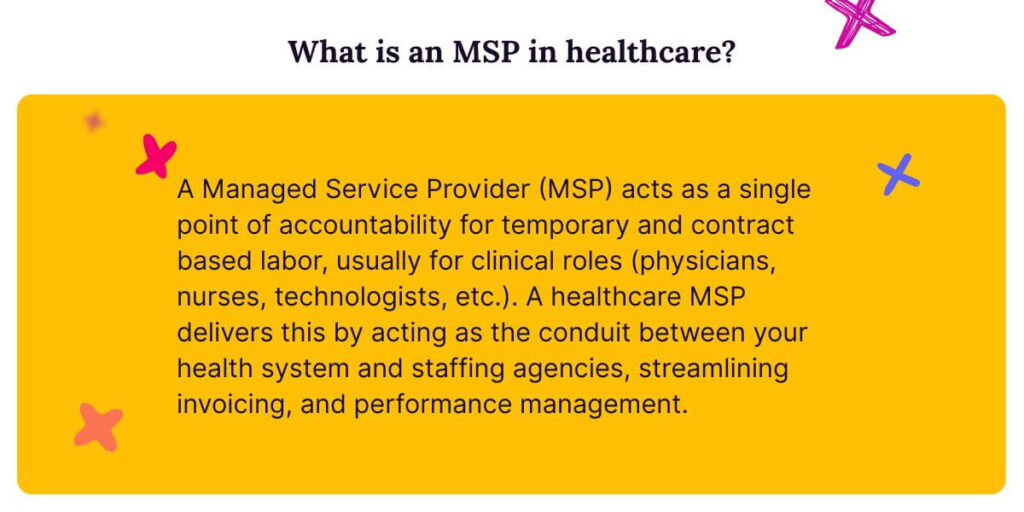
A Managed Service Provider (MSP) acts as a single point of accountability for temporary and contract based labor, usually for clinical roles (physicians, nurses, technologists, etc.). The core value proposition is centralized control, enhanced visibility, and optimized cost. A healthcare MSP delivers this by acting as the conduit between your health system and staffing agencies, streamlining invoicing, and performance management.
What Types of Staffing MSPs Exist in Healthcare?
The two fundamental models are “Vendor-Neutral” and “Proprietary” managed services. A vendor-neutral MSP manages a competitive panel of multiple staffing agencies but has no business objectives ties to any of them. This model fosters competition, driving down bill rates and improving fill rates and service quality. It provides transparency and avoids supplier favoritism, driving down costs. The MSP’s incentive is aligned with yours: to manage the program efficiently, as its fees are not tied to which agency fills the order.
Proprietary MSPs are owned by or have a financial affiliation with a specific staffing agency or a small group of agencies. While it may still manage a limited external panel, there is a built-in incentive to direct the majority of requisitions, or “flow,” to its parent or affiliated company. Often, the affiliated agency is typically given the “first right of refusal” on all open orders. Only if it cannot fill a position does the requisition get opened to other suppliers.
For most multi-facility health systems seeking to maximize value, control cost, and ensure unbiased access to talent, the vendor-neutral model is the clear strategic choice. It establishes a fair, transparent marketplace for contingent labor.
What to Look for in a Staffing MSP
The right MSP acts as an extension of your leadership team, deeply understanding your clinical, cultural, and financial objectives. Beyond basic service-level agreements, executives should evaluate potential partners against the following critical criteria.
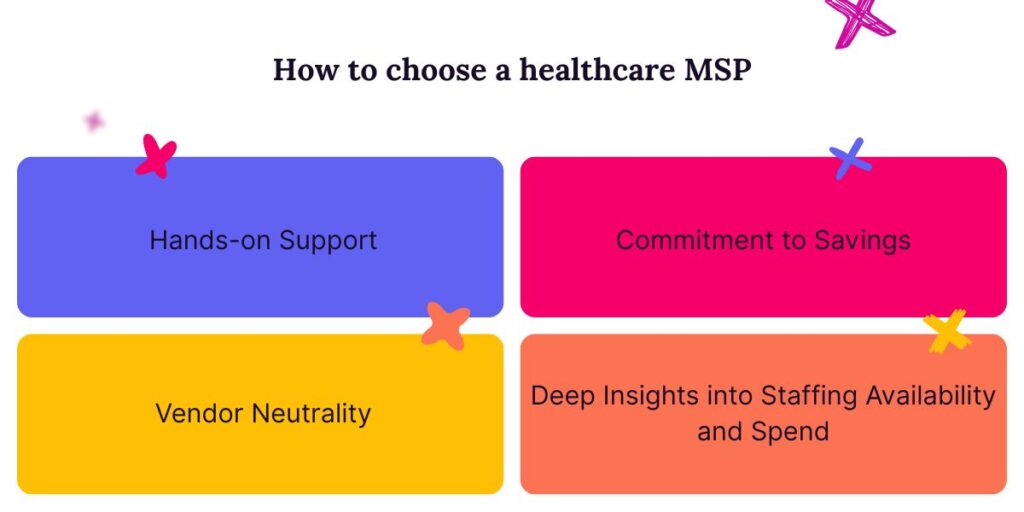
Vendor Neutrality & Diverse Agency Relationships
A truly vendor-neutral model is fundamental to achieving unbiased outcomes and competitive pricing. Executives should seek a partner with a meticulously curated network that includes a mix of national, regional, and specialized niche agencies. This ensures access to both broad talent pools and hard-to-find specialists.
It is essential to understand how the MSP vets, tiers, and performance-manages its agency partners, including its process for refreshing the panel with new, high-performing suppliers. A strong MSP actively cultivates a high-performing marketplace, holding all agencies accountable to the health system’s specific standards and demonstrating how competition within the panel consistently drives down bill rates.
Hands-on Support
Many large agencies and generic MSPs operate with rotating points of contact, leading to frustrating handoffs and a lack of institutional knowledge. Your organization deserves better. You should look for a partner that assigns a consistent, named team to your account, and that person should make an effort to know your leaders, your facilities, and your unique challenges personally.
This means having direct lines to experienced program managers who answer your calls, understand your history without being briefed, and overall act as extensions of your internal team. Evaluate a potential MSP by asking who your specific contacts will be, what their tenure and healthcare background is, and how they ensure continuity.
Commitment to Savings
A critical differentiator among MSPs is their underlying financial philosophy. Executives should be cautious of partners that prioritize funneling volume to a limited number of agencies in exchange for marginal rate discounts. Sustainable savings are derived from active, ongoing rate management and fostering genuine market competition. This requires a proven and transparent methodology for benchmarking bill rates against real-time market data, coupled with a disciplined process for continuous rate negotiation and validation.
Prospective partners should be able to demonstrate a history of intervention that led to direct reductions in average bill rates and articulate the percentage of orders subjected to a competitive bid scenario. Look for case studies and other examples of successful cost savings from your prospective MSP.
Deep Insights into Staffing Availability and Spend
A best-in-class MSP will deliver a predictive intelligence platform. Executives should look for a user-friendly technology portal that offers real-time dashboards providing a holistic view of total workforce spend, utilization trends by unit and specialty, agency performance metrics, and quality indicators. If the tools aren’t readily available to fit the needs of your institution, your MSP should work with you to create a custom solution. The ultimate goal is to transform raw data into actionable intelligence that informs long-term workforce strategy.
How to Choose a Managed Service Provider in Healthcare
Selecting the right Managed Service Provider is not as simple as looking at price comparisons. Instead, you should evaluate long-term partnership potential. The journey begins with a clear assessment of your specific pain points, which usually includes things like unsustainable agency spend, compliance risks, or operational inefficiencies in filling shifts. This internal clarity allows you to measure potential partners for the right features.
With your objectives defined, a thorough request for proposal (RFP) process should focus on the criteria previously outlined: demonstrable vendor neutrality, healthcare-dedicated support models, a proven methodology for generating savings, and the capability to deliver actionable intelligence.
Discussions should explore not just stated outcomes, but the partner’s adaptability during challenges and the true nature of the day-to-day working relationship. The final step is a structured, phased implementation plan co-developed with your selected partner, including setting clear milestones for measuring success from day one.
Our Clients Have Saved Millions with Syncx
The strategic framework for selecting an MSP is not theoretical; it yields tangible, transformative results. For one prominent regional health system, grappling with volatile agency costs and fragmented vendor management, the decision to partner with Syncx unlocked unprecedented value. By implementing our truly vendor-neutral model and disciplined rate management program, the system achieved a remarkable $51 million in savings while simultaneously improving fill rates and clinician quality.
At Syncx, we deliver a partnership defined by deep healthcare expertise, a commitment to unbiased optimization, and a relentless focus on your operational and financial goals. Our integrated technology platform offers the clarity and foresight needed to make proactive staffing decisions, and our dedicated support teams become seamless extensions of your organization.
Experience how Syncx can deliver similar results for you! Schedule a personalized demo today to explore how our tailored approach can bring stability, savings, and strategic insight to your workforce challenges.