The dynamic world of healthcare staffing often leads professionals and administrators alike to encountering a common, yet not always understood, staffing solution: per diem work. For managers and healthcare leaders looking to fortify a unit against unexpected shortages, understanding the ins and outs of this flexible model is crucial. This blog is designed to be your comprehensive guide, demystifying what “per diem” truly means and how it functions within the unique ecosystem of healthcare. We’ll start with the fundamentals, breaking down the key concepts that form the foundation of this essential staffing strategy.
From there, we’ll explore additional questions like, how does per diem differ from a traditional full-time role, or from other temporary models like locum tenens? More importantly, how do you know if this unpredictable but liberating path is the right fit for your facility? In the following sections, we will dive deep into these questions to equip you to make informed decisions, optimize staffing workflows, and ultimately, ensure the delivery of uninterrupted, high-quality patient care.
Defining “Per Diem”
The term “per diem” is a Latin phrase that translates directly to “by the day” or “for each day.” In a general business context, it most commonly refers to a daily allowance of money provided by an organization to an employee to cover work-related expenses incurred while traveling. Beyond travel expenses, “per diem” has evolved into a widely recognized term for a specific type of employment arrangement. In this context, it describes a role where an individual is not a permanent, salaried employee but is instead hired on a daily or as-needed basis. These workers are often brought in to cover short-term staffing gaps, special projects, or periods of high demand.
What Does “Per Diem” Mean in Healthcare?
In the healthcare industry, a “per diem” worker is a licensed or certified professional—such as a physician, nurse, therapist or medical technician—who is not part of a facility’s core, full-time staff. Instead, they work on a flexible, fill-in basis, often without a guaranteed number of hours per week. These professionals are essential to the operational resilience of hospitals, clinics, and long-term care facilities, acting as a vital flexible workforce that can be deployed where and when they are needed most.
The role of a per diem healthcare professional is distinct from that of a traveler or locum tenens from a staffing agency. While travel healthcare professionals typically commit to short-term contracts in a specific location, per diem workers usually operate on an even shorter timeline. They are employed directly by the healthcare facility or through a local staffing pool to address last-minute call-outs, sudden increases in patient acuity, or seasonal fluctuations in patient volume, ensuring that the standard of care remains high even when the regular staff is stretched thin.
How Does “Per Diem” Work in Healthcare?
The practical mechanics of per diem work in healthcare are built on flexibility and choice. Healthcare facilities maintain a roster of qualified per diem professionals who have completed their credentialing and onboarding processes. When a staffing need arises—such as a physician calling in sick or a higher-than-expected patient census—the unit manager or staffing coordinator will reach out to available per diem workers, often through a scheduling system or app, to fill the open shift. The per diem employee has the freedom to accept or decline the shift based on their own schedule.
Per diem workers are paid a premium hourly wage that is often significantly higher than the rate for a full-time employee in a similar role. This higher pay rate serves to offset the lack of standard employment benefits such as health insurance, paid time off, or retirement contributions.
What’s the Difference Between Per Diem Work and Traditional Employment?
The most significant difference between per diem work and traditional employment lies in the structure of the work relationship and the associated benefits. A traditional, full-time employee works a set schedule, often of 40 or more hours per week, with a consistent, predictable paycheck. In return for this stability, they receive a comprehensive benefits package that typically includes health insurance, paid time off (sick days and vacation), retirement plans like a 401(k), and often, employer-sponsored malpractice insurance. This model provides long-term financial security and is the backbone of a healthcare facility’s core staffing.
In contrast, a per diem employee has no guaranteed hours and functions as an internal float pool member, working only when they choose to accept available shifts. The trade-off for this extreme flexibility is the absence of standard employment benefits. Per diem workers that are not on a W-2 are responsible for securing their own health insurance and saving for retirement without employer contributions. However, despite the lack of benefits and job security, they command a substantially higher hourly wage.
What’s the Difference Between “Per Diem” and Locum Tenens?
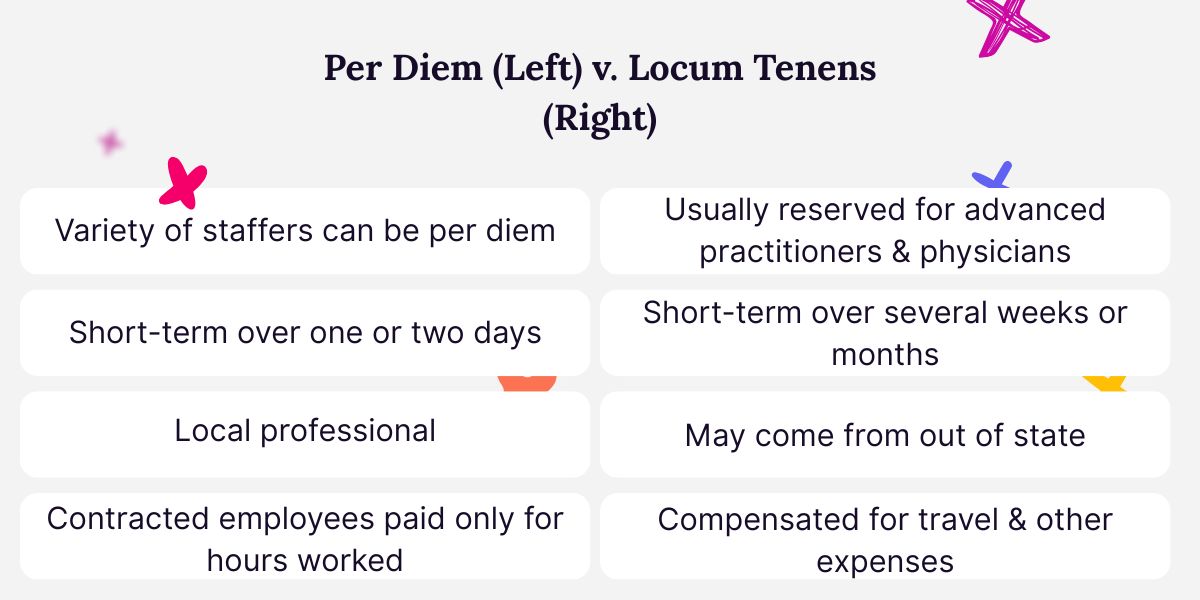
While both per diem and locum tenens roles involve temporary work, they differ significantly in scope, duration, and typical application. Per diem work is characterized by its short-term, often day-to-day nature. A per diem physician, for instance, might work a single 8 or 12-hour shift to cover a sick call at a local hospital. They are generally local professionals who work within a specific geographic area and are integrated into a facility’s internal flexible workforce, often being employed directly by the hospital system itself.
Locum tenens, a Latin phrase meaning “to hold the place of,” is a term almost exclusively used for physicians and advanced practice providers (APPs) like Nurse Practitioners and Physician Assistants. These assignments are much longer, typically ranging from several weeks to many months, and are designed to provide continuous coverage for a provider who is on leave, or to fill a permanent position until a replacement is found.
Locum tenens providers usually travel to different locations, sometimes across the country, and are almost always employed through a specialized staffing agency that handles their travel, housing, and licensure for each assignment, representing a more formalized and large-scale temporary placement.
When to Hire Temporary Healthcare Staff
For hospital and health system leaders, the strategic deployment of temporary workers is a crucial component of cost-effective workforce management. The decision to bring in per diem or locum tenens staff should be proactive and data-driven. Key triggers include
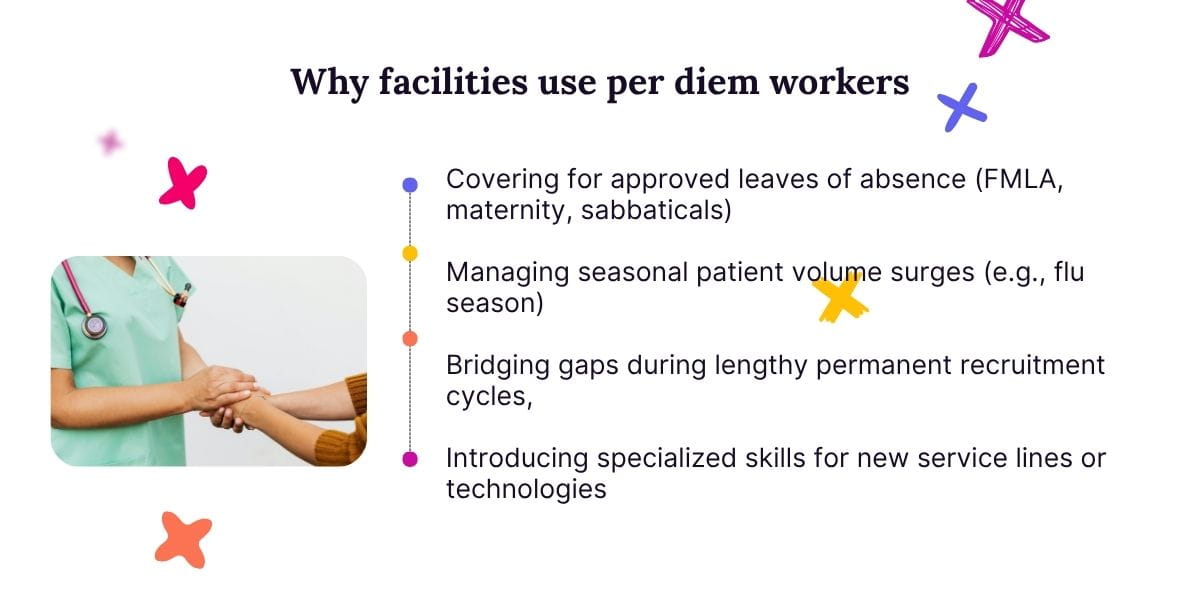
- Covering for approved leaves of absence (FMLA, maternity, sabbaticals)
- Managing seasonal patient volume surges (e.g., flu season)
- Bridging gaps during lengthy permanent recruitment cycles,
- Introducing specialized skills for new service lines or technologies
Furthermore, leveraging temporary staff is an essential strategy to mitigate burnout among your core team by preventing chronic understaffing, thereby protecting your permanent employees while maintaining high levels of patient safety and satisfaction.
Fill Staffing Gaps Fast
Ready to experience how a strategic partnership can transform your staffing challenges? Discover the power of streamlined, reliable locum tenens coverage with a personalized demo from Syncx. Take your contingent staff management in house with a custom float pool solution from Syncx. Our managed services platform is designed to give you back your time, placing a dedicated team of experts between you and the complexities of credentialing, scheduling, and billing. See firsthand how Syncx delivers vetted, high-quality providers precisely when and where you need them, ensuring continuity of care and operational stability.
Contact us today to schedule your free, no-obligation demo and see the Syncx difference for yourself.