Most advice on choosing a locum tenens agency comes from the agencies themselves. Or from consultants who are aligned with one vendor’s preferred partner network. It’s hard to find a truly neutral, experience-based perspective.
That’s exactly why we’re writing this article.
Syncx is a vendor-neutral managed services provider. That means we don’t place locums, and we don’t steer you toward one agency over another. We help hospitals manage all their agency relationships through a single software and services platform.
Over the years, we’ve seen what works for healthcare facilities and what frustrates them. And we’ve developed strong opinions about what healthcare organizations should look for when choosing a locums partner.
Let’s talk candidly about what any agency should offer you in terms of responsiveness, accountability, and transparency.
Who Are We?
We’re Syncx, and we’re not a locum tenens agency. We don’t place physicians, negotiate clinician rates, or try to become your single source for coverage.
Instead, we’re a vendor-neutral managed services provider built specifically for healthcare organizations that want to stay in control of their locum tenens strategy by having more visibility into what they’re spending.
Over the past several years, we’ve worked with dozens of locum tenens agencies across the country. We are also staffed by people with decades of experience in the field. That means we’ve seen the wide variance in markups, contract terms, fill times, and compliance quality. And we’ve watched health systems struggle to manage those relationships manually.
We built Syncx to solve that. Our software and managed services give facilities a single, neutral system to:
- Manage all their existing agency relationships
- Control which locums positions get opened to which agencies
- Track real-time spend and fill performance
- Reduce administrative friction without giving up negotiating leverage
Because we’re not an agency, we have no incentive to push you toward one vendor over another. We don’t steer volume to a preferred partner. Our only goal is to help you run a more efficient, data-driven locum tenens program using the agencies you already trust (or finding new ones if that’s what you want).
This article is our attempt to share what we’ve learned from sitting between dozens of health systems and hundreds of agency relationships, starting with how to choose the right locum tenens agency for your organization.
What We Like About Small and Mid-Size Agencies
Let’s be clear: large locum tenens agencies serve an important role. They have deep national rosters, established compliance infrastructure, and the ability to scale quickly for high-volume needs. We work with plenty of them, and our clients do too.
But over years of managing relationships between dozens of health systems and locums agencies of all sizes, we’ve noticed something consistent: smaller agencies often excel in the human dimensions of the business, i.e. the parts that directly impact your fill time, your stress level, and your ability to control costs.
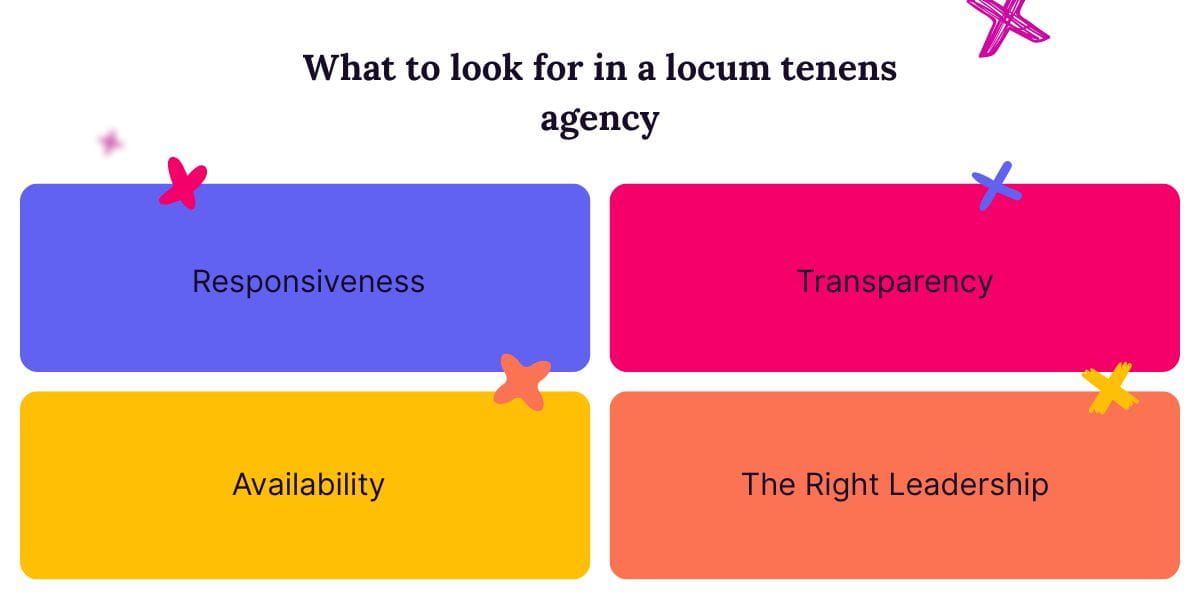
Here’s what we mean. These four qualities matter for any agency you work with, large or small. We’ve just seen small agencies deliver them more reliably.
Responsiveness
When you have an open shift or a last-minute cancellation, you don’t need a perfect answer immediately, but you do need someone to pursue that answer rigorously and keep you updated in the process. As our Director of Client Solutions, Whitney Fields, put it, “if your staffing vendor requires daily check-ins just to tell you where your reqs are, they are not a partner. They are a project.”
Large agencies often route inquiries through central intake systems, ticketing queues, or rotating account teams. That means your requests can often take longer to fulfil. Small agencies tend to connect you directly with an account manager who knows your organization. That person answers their own phone or returns emails within minutes, not hours. They may not have every candidate lined up instantly, but they acknowledge you quickly, set expectations honestly, and start problem-solving immediately.
For any agency you evaluate, ask: How fast will I speak to a live person who knows my account? What’s the actual response time for a new open position?
Availability
While you will usually have multiple people working on your account, with the right agencies, you will usually be connected with a point of contact who oversees your entire relationship, and you’ll know who they are from the start. Over time, that manager should know your preferred rates, your compliance requirements, and your culture. They stay in regular contact because they own the relationship.
And when something goes wrong, you don’t get transferred. You get resolution.
For any agency you evaluate, ask: Will the person I’m in daily contact with have decision making power? How often will I hear from them proactively, not just when there’s a placement?
Transparency
Steer clear of agencies that use complex bill rate structures, stacked markups, or tiered “preferred vendor” arrangements that obscure what a clinician is actually being paid versus what you’re being charged.
Another reason we like small agencies (especially those founded by industry veterans who left larger firms) is because they’re more likely to say, “Here’s what we pay the clinician, and here’s our margin.” That clarity helps you manage spend, benchmark fairly, and build a relationship based on trust rather than negotiation games.
For any agency you evaluate, ask: Will you show me the clinician’s pay rate and your margin separately? Is that margin fixed or variable?
A different kind of leadership
Many small agencies aren’t just small by accident. They were founded by experts who spent years inside large locums firms, saw broken incentives, and decided to build something better.
These leaders prioritize ethical markups, clinician well-being, long-term partnerships, and honest communication and make real effort to earn your business year after year.
That doesn’t mean large agencies can’t do these things, but we’ve observed that smaller, mission-driven agencies start from a different place, and that difference shows up in responsiveness, availability, and transparency.
The Bottom Line
No matter who you work with, your agency should consistently deliver better fill times, clearer communication, and fairer pricing. For hospitals willing to manage multiple agency relationships (instead of consolidating to one giant vendor), small and mid-size agencies offer a real competitive advantage.
Looking for a partner that can introduce you to some niche agencies? Or just wanting to take back control of your locums spend? We’d love to give you a free, customized demo of our platform.