For most CFOs in healthcare, locum tenens spend exists in a frustrating paradox. Agency rates rise with demand. Travel and lodging costs fluctuate unpredictably. And every time a department head calls with an urgent staffing gap, saying no is not an option. Patient care cannot wait. So the agency gets the call, and another expensive shift gets filled at a 30 to 60 percent markup over what it would cost to use an internal clinician.
The traditional response has been to negotiate harder with agency partners or to cap bill rates. But as long as your organization has no credible alternative to agency labor, you have no leverage. Agencies know this. That is why locum rates have climbed steadily even as healthcare margins have compressed.
This article offers a different path. It makes the case that CFOs can gain lasting control over locum tenens spend by building an internal asset: a dedicated float pool of W-2 and 1099 clinicians who fill gaps at a fraction of the cost of agency labor. You will learn the hidden costs that most P&Ls miss, how to build a business case, how to operationalize a float pool without creating new inefficiencies, and how one health system saved more than $51 million by taking locums internal.
By the end, you will have a practical roadmap for turning locum tenens from a chronic budget headache into a source of predictable, sustainable margin improvement. Let’s get started.
The Hidden Costs of Locum Tenens
The true cost of relying on temporary staffing runs deep, and often silently erodes margin, productivity, and permanent staff retention. CFOs who only track the bill rate miss the iceberg below the surface.
The surgical specialties and subspecialties of internal medicine have the highest mark-ups. Neurosurgery and urology, for example, command premium rates because there is a very small pool of specialists that are active in those areas. Beyond the bill rate, each locum assignment can include flights, rental cars, and lodging, adding as much as $2,000-$4,000 per week in travel and lodging expenses.
Frequent handoffs between rotating locums increase the risk of communication failures, duplicate orders, and longer lengths of stay. If you have not run a fully loaded cost analysis of your locum spend that includes agency fees, travel and housing, operational friction, and turnover impact, you are likely underestimating true cost by 40 to 60 percent. That gap is the financial rationale for an alternative model.

What Is an Internal Float Pool?
An internal float pool is a dedicated workforce of clinicians who fill scheduled and unplanned gaps across your system at a fraction of the cost of agency labor. Instead of being assigned to a single department or site, these clinicians float across the organization to cover planned leaves such as vacations or parental leave, unexpected absences from sick calls or turnover gaps, and seasonal or census-driven surges.
A well-designed float pool often includes a combination of employed (W2) and independent contract (1099) providers, allowing organizations to align coverage strategies with both operational and financial goals. W2 providers can offer consistency, cultural alignment, and long-term workforce stability, while 1099 providers provide flexible, scalable coverage that can help address fluctuations in demand, seasonal volume changes, leave coverage, or hard-to-fill shifts without permanently increasing fixed labor costs.
Building the Business Case for Internal Locums
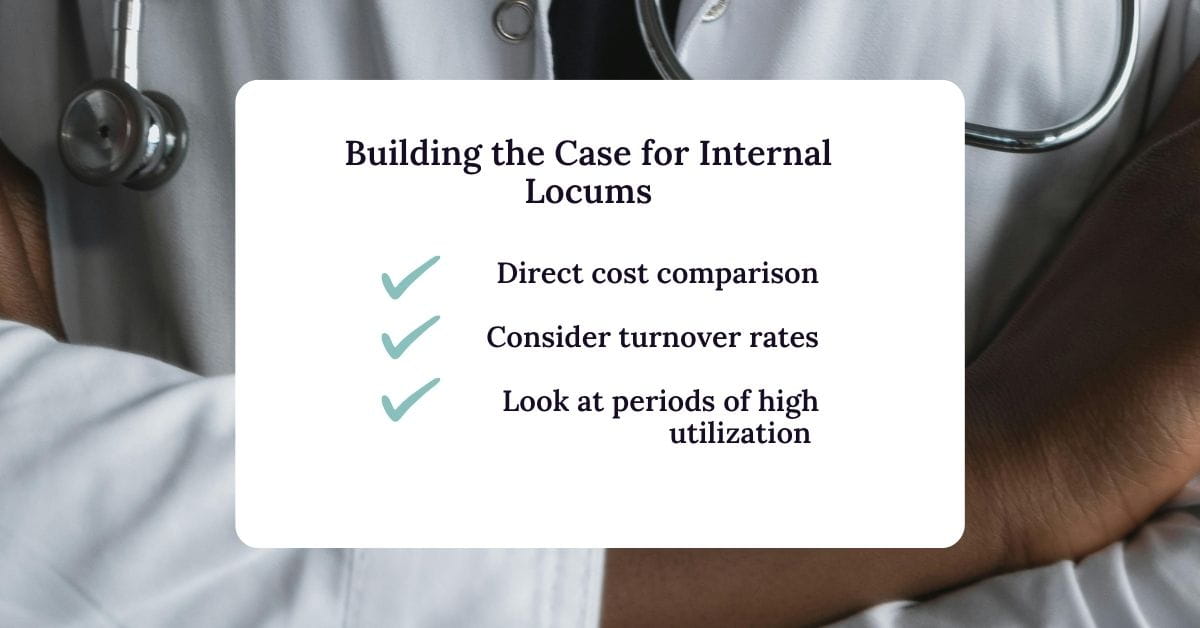
Many CFOs assume that adding employed float clinicians will simply shift costs from one column to another without delivering real savings. But when you compare the fully loaded cost of an agency locum against that of an internal float clinician, the math quickly favors the internal model.
Start with the direct cost-per-day comparison. For example, you might be paying a locums Anesthesiologist at a rate of $489/hour, but you could fill that same shift with someone from your float pool for closer to $330/hour. Doing so saves you 32% or $159/hour. But the business case does not stop there.
Two additional financial drivers make the internal float pool even more attractive. First, you reduce or eliminate travel and lodging spend entirely by hiring float clinicians from within your local or regional market. Second, you decrease turnover among permanent clinicians by reducing the excessive weekend, holiday, and on-call burden that drives burnout.
Get a Personalized Float Pool Demo
You now have the framework: the hidden costs of locum tenens, the definition and financial logic of an internal float pool, the business case, the operational playbook, the risks, and a real-world case study showing $51 million in savings.
But every health system is different. Your mix of specialties, your geographic footprint, your existing agency relationships, and your internal political landscape all shape what a successful float pool looks like for you.
That is where Syncx comes in. Syncx helps CFOs and health system leaders move beyond theory and into execution. Whether you are starting from scratch with no float pool today or you have an underutilized pool that is not delivering the savings you expected, Syncx provides the strategic guidance, technology, market rate data, and the vendor-neutral MSP model to make it work.
The only way to gain control of locum tenens spend is to build a credible alternative. That work starts with a conversation. Reach out to us today for a free, personalized demo.