
Every year, health systems spend millions on locum tenens coverage to keep critical services running. Yet many organizations have an opportunity to reduce that spending by making better use of physicians and advanced practice providers (APPs) already connected to their health system. The challenge isn’t always a lack of providers. Sometimes it’s a lack of visibility into who’s available, where coverage is needed, and how to connect the two. An internal physician and APP float pool helps solve that problem.
By organizing existing resources, identifying additional provider capacity, and using technology to coordinate coverage, health systems can fill more shifts internally before turning to costly external locums agencies.
Here’s how physician float pools work, why they’re different from nursing float pools, and how health systems can use them to gain greater control over staffing costs.
What Is a Float Pool in a Hospital?
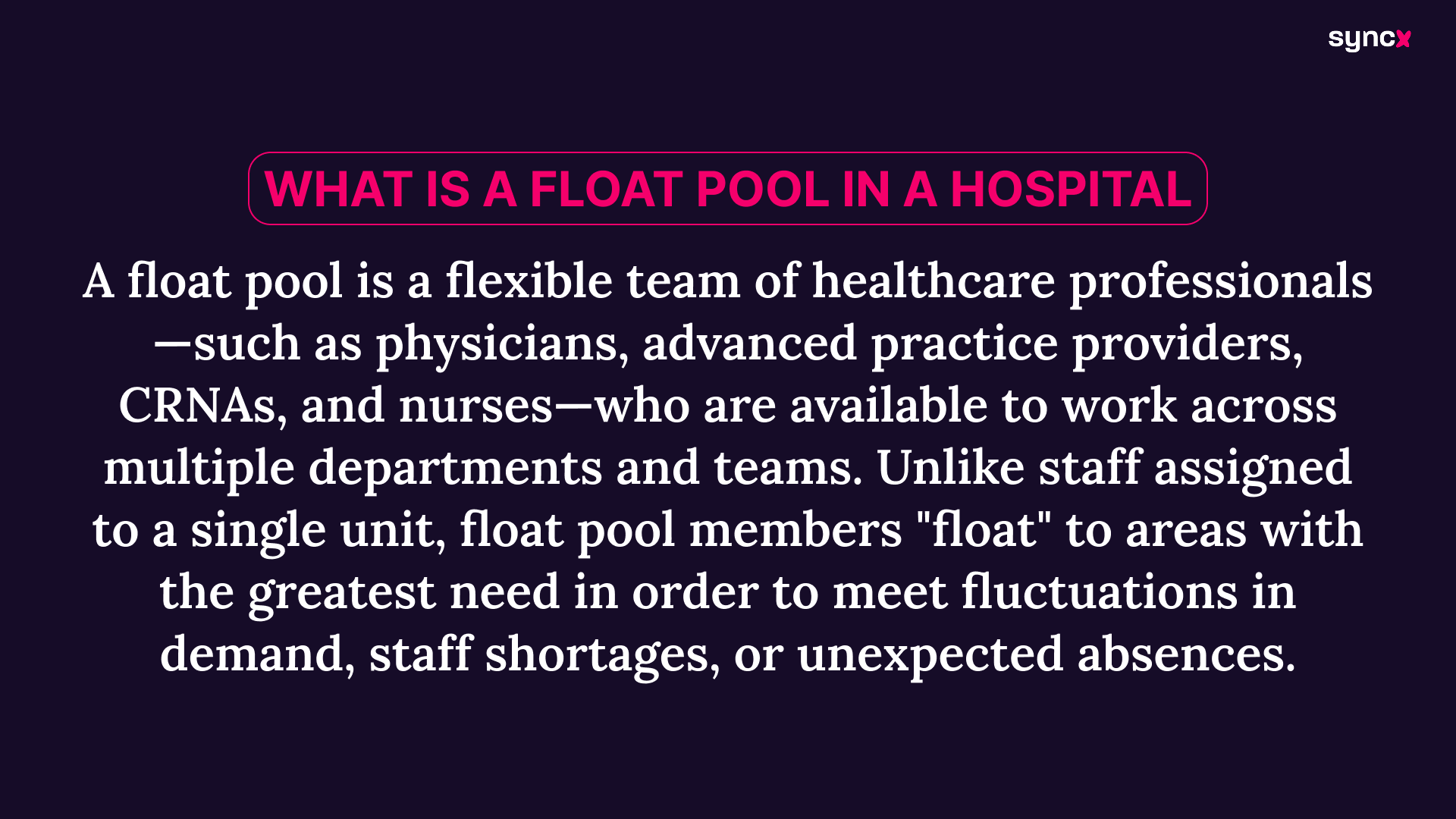
A hospital float pool is a group of qualified healthcare professionals who provide flexible coverage when and where additional staffing is needed.
While many people associate float pools with nursing, the concept can also apply to physicians and advanced practice providers.
An internal physician and APP float pool gives health systems a structured way to identify,
engage, and schedule qualified providers to cover open shifts across their organization.
These providers might include employed physicians with additional availability, part-time or PRN providers, physicians approaching retirement who want more flexible schedules, or qualified clinicians recruited into the health system’s internal coverage program.
Rather than automatically turning to an external locums agency when a need arises, health systems can first identify whether an appropriate internal resource is available.
The result is a more coordinated approach to managing supplemental provider coverage, with the potential to significantly reduce external staffing costs.
How Is a Physician Float Pool Different From a Nursing Float Pool?
Nursing float pools have been common in hospitals for years, but physician and APP float pools operate differently.
A nursing float pool typically allows appropriately qualified nurses to move between hospital units based on staffing needs, patient census, and acuity.
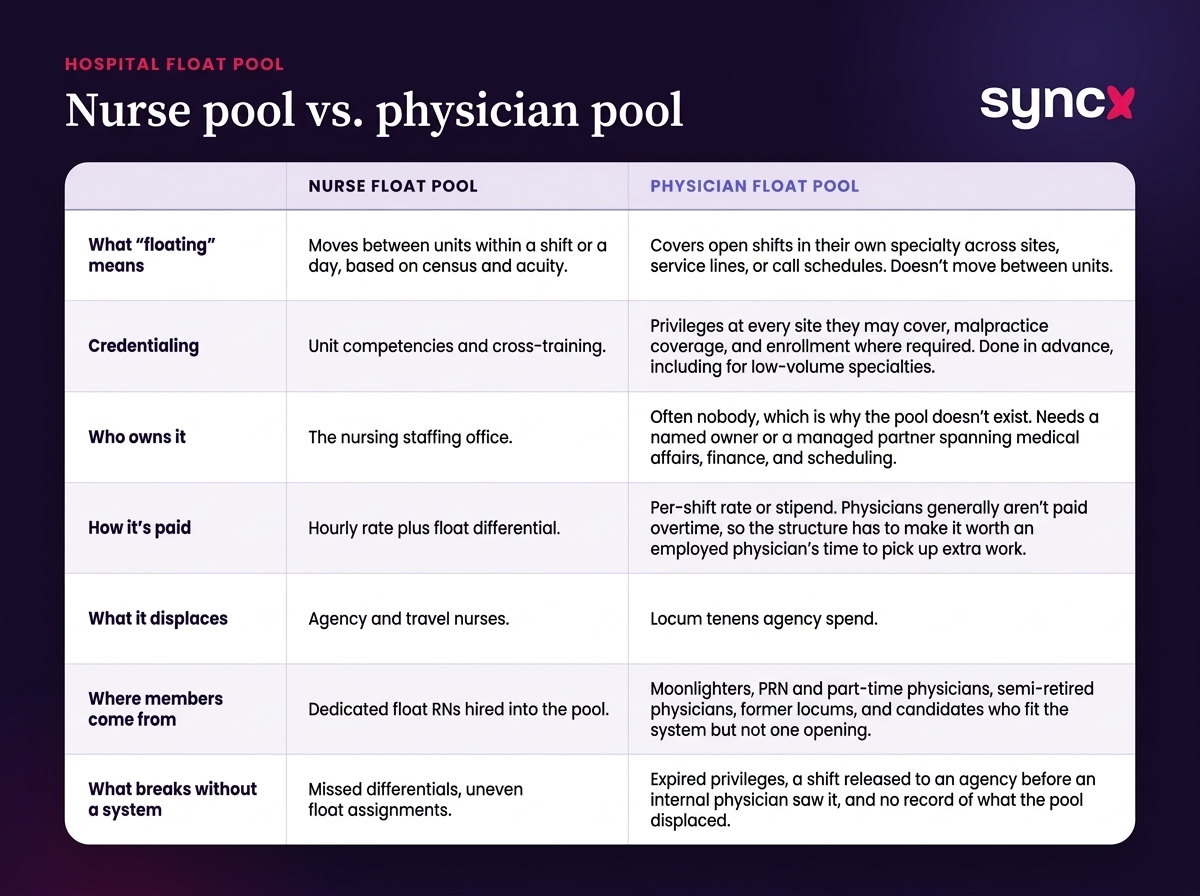
A physician float pool isn’t about moving physicians between departments. It’s about matching qualified providers with appropriate clinical coverage opportunities based on their specialty, credentials, privileges, availability, and the needs of the health system.
For example, a health system might have recurring hospitalist coverage needs at multiple facilities. Rather than sourcing every opening through an outside agency, it could use an internal float pool to identify qualified hospitalists who are available to cover those shifts.
The same approach can work across specialties, including emergency medicine, anesthesia, OB/GYN, and others where supplemental coverage is frequently needed.
The objective is to make better use of the clinical resources already available to the organization while strategically building additional internal capacity.
Why Are Health Systems Investing in Internal Physician Float Pools?
The biggest opportunity is financial, but the benefits extend well beyond cost savings.
1. Reduce Dependence on Expensive Locum Tenens Agencies
External locum tenens providers serve an important purpose when a health system cannot meet its coverage needs internally. However, consistently relying on agencies to fill recurring openings can create substantial and avoidable expenses.
Health systems may pay agency markups along with additional costs related to travel, lodging, and other assignment expenses.
An internal float pool provides an alternative.
By filling appropriate shifts with providers engaged directly through the health system, organizations can reduce the number of shifts sent to external agencies.
Internal float pool coverage can reduce hourly staffing costs by approximately 20% to 30% compared with agency locums, depending on specialty, compensation arrangements, and program structure.
Across hundreds or thousands of shifts, those savings can add up quickly.
2. Make Better Use of Existing Provider Capacity
Many health systems have more internal flexibility than they realize.
A physician at one facility may have availability to cover an opening at another. A part-time provider might welcome additional shifts. A physician who has stepped away from full-time practice may be interested in occasional coverage.
Without centralized visibility, those opportunities can be missed.
An internal float pool brings available providers and open shifts into a more coordinated process, helping health systems identify qualified resources that might otherwise go unused.
3. Gain Greater Visibility and Control
In decentralized organizations, individual hospitals or departments may manage physician coverage independently.
One facility may be paying an agency to fill a shift while another has an appropriately qualified provider interested in supplemental work.
Without shared visibility, leaders may not recognize these opportunities.
A centralized float pool gives health systems greater insight into provider availability, recurring coverage needs, internal utilization, and opportunities to reduce external staffing costs.
That visibility also helps finance and operational leaders understand where locums spending is occurring and where internal alternatives may be developed.
4. Create More Flexible Opportunities for Providers
Not every physician or APP wants a traditional full-time schedule.
Some want to supplement their income. Others prefer part-time work, occasional assignments, or the flexibility to choose when and where they practice.
An internal float pool can help health systems retain and engage these providers by offering opportunities that align with their professional and personal priorities.
It can also create a pathway for experienced physicians approaching retirement to remain clinically active without maintaining a full-time workload.
For health systems, that means retaining valuable clinical experience while creating additional internal coverage capacity.
What’s the Difference Between an Internal Float Pool and Locum Tenens Staffing?
Both internal float pools and external locum tenens agencies help health systems maintain physician and APP coverage, but the sourcing and cost structures are different.
An internal float pool consists of qualified providers who are engaged directly through the health system’s internal coverage program. These providers may already be employed by the organization or may be recruited specifically to provide supplemental coverage.
External locum tenens agencies source and place providers through third-party staffing arrangements.
Agency resources can be valuable when internal capacity is insufficient, but they generally introduce additional costs associated with the agency relationship.
The financial opportunity comes from changing the order in which health systems approach coverage.
Instead of automatically releasing every open shift to an external staffing agency, organizations can establish processes that prioritize available internal resources.
When qualified internal providers aren’t available, external locums can fill the remaining need.
This approach helps health systems reduce unnecessary agency utilization while maintaining the flexibility to meet patient care demands.
How Does Physician Float Pool Technology Work?
Managing an internal physician float pool requires more than maintaining a list of available providers.
Health systems need a coordinated way to identify coverage needs, understand provider availability, communicate opportunities, and track how their internal resources are being used.
Float pool management is supported by technology that helps health systems centralize physician and APP scheduling, improve visibility into available providers, and manage open shifts across multiple facilities.
Rather than relying on spreadsheets, emails, and disconnected scheduling processes, health systems can use a single platform to identify qualified providers, communicate available opportunities, and coordinate coverage based on specialty, credentials, privileges, and availability.
The technology also supports credentialing, timekeeping, and reporting, giving health systems greater visibility and control over how their internal resources are utilized. Automated notifications help communicate open shifts and keep providers engaged, while centralized data allows leaders to identify staffing patterns, measure float pool utilization, and uncover opportunities to fill more shifts internally.
The result is a more efficient, coordinated approach to physician and APP staffing that helps reduce reliance on costly external locum tenens agencies.
How Do Health Systems Build an Internal Physician Float Pool?
Building a successful float pool requires more than purchasing scheduling software. It takes a deliberate strategy for identifying provider resources, engaging clinicians, managing coverage, and measuring results.
Here are six important steps.
Step 1: Understand Where Locums Are Being Used
Start by analyzing external locums utilization across the organization.
Which specialties consistently require supplemental coverage? Which facilities have recurring openings? Where are the largest staffing expenses?
Identifying these patterns helps health systems prioritize the areas where an internal float pool could have the greatest financial impact.
For many organizations, the best starting point is a specialty with significant recurring coverage needs and an opportunity to develop qualified internal resources.
Step 2: Identify Existing Provider Capacity
Before recruiting additional providers, understand which resources are already available.
Look at employed physicians interested in supplemental shifts, part-time providers, PRN clinicians, and experienced physicians seeking more flexible schedules.
Consider whether appropriate providers at one facility could provide coverage at another location within the health system.
This step often reveals opportunities that haven’t been visible through existing staffing processes.
Step 3: Strategically Expand the Pool
Existing provider availability may not be enough to meet every coverage need.
Health systems can proactively recruit physicians and APPs who are interested in joining their internal coverage program, including qualified clinicians who prefer flexible or supplemental work.
The goal is to build a dependable pool of providers aligned with the specialties, locations, and coverage patterns where external locums utilization is highest.
Recruitment should be guided by actual demand rather than simply trying to build the largest possible provider pool.
Step 4: Establish Clear Processes and Accountability
A float pool needs clearly defined processes for provider eligibility, scheduling, compensation, credentialing, clinical privileges, and communication.
Health systems should determine which teams are responsible for provider engagement, scheduling decisions, clinical oversight, and program performance.
The right operational structure makes it easier for departments to use internal resources consistently while ensuring providers meet the requirements of each assignment.
Step 5: Make Internal Coverage the First Option
A successful float pool should be integrated into the organization’s broader staffing strategy.
When coverage needs arise, schedulers should be able to identify whether appropriately qualified internal providers are available before pursuing external agency resources.
Centralized technology makes that process more efficient by improving visibility, communication, and coordination across facilities.
The objective is straightforward: maximize internal capacity before incurring unnecessary external staffing costs.
Step 6: Measure Performance and Continuously Improve
Establish clear performance metrics and review them regularly.
Important measures include:
- Internal float pool utilization and fill rates
- Reduction in external agency shifts and hours
- Cost savings compared with equivalent agency coverage
- Growth and engagement of the internal provider pool
- Recurring coverage gaps by specialty and facility
These insights allow health systems to identify what’s working, where opportunities remain, and how to expand the program strategically.
How Much Can a Physician Float Pool Save?
The financial impact depends on several factors, including specialty mix, historical locums utilization, provider compensation, and the number of agency shifts that can be covered internally.
Syncx has seen opportunities for health systems to reduce hourly coverage costs by approximately 20% to 30% when shifting appropriate assignments from external locums agencies to internal float pool providers.
Consider a hypothetical example.
A health system spends $5 million annually on external locums coverage. Through an internal float pool, it successfully transitions $2 million of comparable agency-covered work to internal providers.
At a 25% reduction in coverage costs, that represents approximately $500,000 in savings before accounting for program expenses and other applicable costs.
The larger the volume of appropriate shifts moved from agency coverage to internal providers, the greater the potential financial impact.
And the benefits can continue to grow as the health system identifies additional providers, expands coverage into more specialties, and uses historical staffing data to plan more proactively.
For health systems with substantial recurring locums utilization, a well-managed float pool can become an important component of long-term workforce cost management.
How Do You Know If Your Float Pool Is Working?
A successful float pool shouldn’t be measured simply by the number of providers enrolled.
The more meaningful question is whether the health system is using those resources to reduce external agency utilization and improve staffing efficiency.
Health systems should regularly evaluate how many eligible shifts are filled internally, how many agency shifts have been avoided, and how much the organization has saved.
It’s also important to understand which specialties continue to rely heavily on outside agencies and whether additional internal recruitment could address those gaps.
These measurements help leaders distinguish between a pool that exists on paper and one that is producing meaningful operational and financial results.
Frequently Asked Questions About Hospital Float Pools
Is a physician float pool the same as a nursing float pool?
No. Nursing float pools generally use appropriately qualified nurses to provide coverage across hospital units based on staffing requirements. Physician and APP float pools focus on matching clinicians with appropriate coverage opportunities based on specialty, credentials, privileges, and availability.
Are float pool physicians employees of the hospital?
They can be, but not always. Depending on the health system’s program structure, participants may include employed physicians, PRN providers, or clinicians engaged through other direct arrangements with the organization. The defining characteristic is that the health system is developing and managing its own provider resources rather than relying exclusively on third-party staffing agencies.
Is a float pool the same as PRN staffing?
Not exactly. PRN generally refers to an as-needed work arrangement. An internal float pool is a broader program that organizes qualified providers, their availability, and clinical coverage opportunities. PRN physicians and APPs may be part of that pool, along with other appropriately engaged providers.
Can a physician work at multiple hospitals within the same health system?
Yes, when appropriately qualified and authorized to practice at each location. Physicians must meet applicable credentialing, privileging, licensing, and other requirements for the facilities and services where they provide care.
How large does an internal float pool need to be?
There is no universal number. The appropriate size depends on the health system’s coverage needs, specialty mix, facilities, and available provider resources.
Many organizations benefit from starting with a few high-demand specialties and expanding the pool as the program demonstrates results.
Do internal float pool providers get paid more?
Compensation arrangements vary by organization, specialty, employment status, and coverage requirements. Some providers may receive supplemental shift payments or other compensation for additional work.
The objective is to establish compensation arrangements that attract qualified providers while maintaining favorable economics compared with external agency coverage.
Can a hospital operate both an internal float pool and a locums MSP?
Absolutely.
An internal float pool and a managed services provider (MSP) program can complement one another.
The float pool helps health systems maximize qualified internal resources, while an MSP provides centralized management of external locums agencies when additional coverage is required.
Together, these approaches can provide better visibility into staffing, more consistent processes, and greater control over total locums spend.
How Syncx Helps Health Systems Build and Manage Internal Float Pools
Syncx helps health systems take a more strategic approach to physician and APP staffing by making internal provider resources easier to identify, engage, schedule, and manage.
Our float pool technology supports centralized scheduling, provider communication, credentialing visibility, timekeeping, and reporting, giving organizations a more coordinated way to manage supplemental coverage across their facilities.
Whether a health system is establishing its first internal float pool or expanding an existing program, Syncx helps bring the technology, expertise, and operational support needed to make internal coverage more accessible and effective.
And when combined with Syncx’s MSP solution, health systems gain a more comprehensive approach to managing both internal and external physician staffing resources.
The goal is simple: identify available internal capacity, build a stronger provider pool, fill more shifts without an agency, and reduce locums spend wherever possible.
Ready to Reduce Your Locums Spend?
Your health system may have more opportunities to reduce external staffing costs than you realize.
Let’s look at where you’re relying on locum tenens today and identify opportunities to build or expand an internal physician and APP float pool.
Connect with Syncx to explore your float pool opportunities.